
Can You Return to a Wedding? Spatial Video, 3D Venues and the New Memory Layer
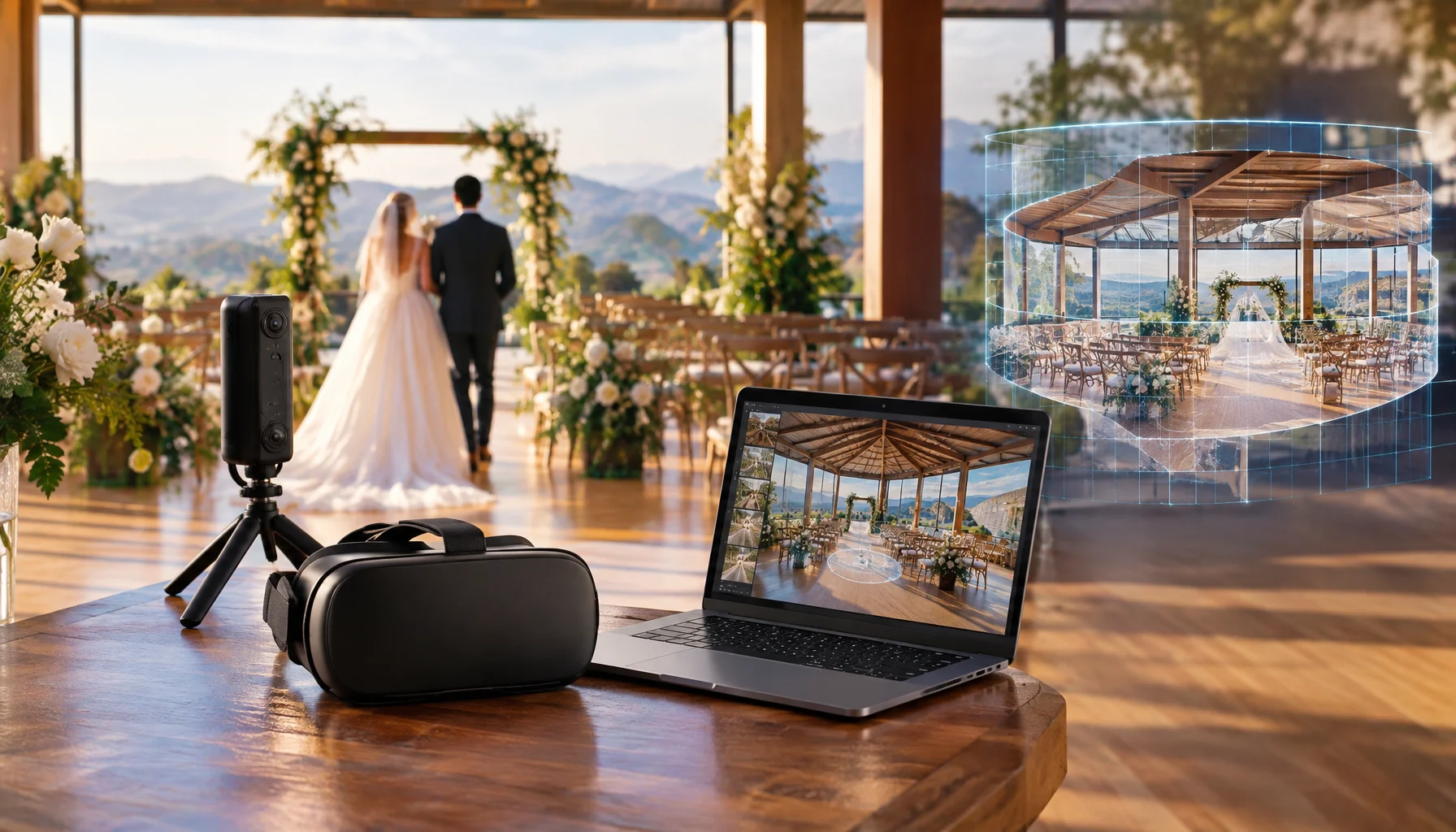
Traditional wedding media gives you a viewpoint. A photograph chooses a frame. A film chooses a sequence of frames. Immersive media begins with a different ambition: preserving enough information about depth, direction or space that the viewer can experience more than the original camera window.
That does not yet mean creating a perfect digital duplicate of a wedding that people can freely walk through forever. Some forms of immersive capture are already accessible with consumer cameras and phones. Others require specialist lenses, scanning workflows, headsets or dedicated volumetric studios.
The Presence Ladder: five different ways media can become spatial
The word immersive hides several very different capture models. The most useful distinction is how much freedom the viewer has after the wedding.
What can the future viewer actually do?
| Spatial video | 180° / 360° video | 3D space capture | Volumetric person | |
|---|---|---|---|---|
| Perceive depth | Yes | Can be stereoscopic depending on capture | Yes | Yes |
| Look in another direction | Limited by the recorded frame | Yes, within the captured field of view | Yes | Viewer can change view around the subject |
| Move to another viewpoint | No meaningful free movement through the original scene | Normally viewpoint remains near the original camera position | Yes, within the reconstructed environment | Yes, around the reconstructed subject within the experience |
| Wedding strength | Intimate people-focused moments | Ceremony or performance presence | Venue, decor and environmental memory | People as three-dimensional recorded performances |
| Practical maturity | Consumer-accessible today | Commercially available with specialist and prosumer equipment | Commercially mature for static spaces | Real, but specialist and production-intensive |
Spatial video is already a consumer capture format
Spatial video is one of the most immediately practical forms of immersive wedding media because it no longer requires a dedicated film studio. Supported iPhones can capture spatial photographs and videos that can later be viewed with depth on Apple Vision Pro.
Apple's current workflow records separate stereoscopic views and stores them in MV-HEVC media. The result still behaves like a composed shot — you do not gain complete freedom to walk around the original wedding — but the image contains binocular depth that ordinary 2D video does not preserve.
That distinction makes spatial video especially interesting for small human moments: a parent sitting across a table, someone reading a letter, preparations in a quiet room, the couple speaking directly to the camera, or several people standing at conversational distance.
Spatial wedding capture is already moving beyond phones
Dedicated camera systems also exist. Canon's current EOS VR System includes stereoscopic and dual-fisheye lenses intended for 3D and VR production.
Canon explicitly lists weddings among the use cases for its RF-S 3.9mm F3.5 STM DUAL FISHEYE system. That matters because immersive wedding capture is no longer only a theoretical extension of VR filmmaking; equipment manufacturers are already positioning suitable capture systems for real events.
The production logic is still different from ordinary wedding filmmaking. Dual-lens capture introduces stereoscopic alignment, viewing comfort, field-of-view decisions and a delivery format that the client must actually be able to watch.
180° video changes where the viewer stands
A conventional wedding film continually tells the viewer where to look. A wide immersive recording can transfer some of that control back to the viewer.
Place a 180° camera close to the front of a ceremony and a future viewer may choose to look toward the couple, turn toward family reactions or study the architecture around them. The camera position remains fixed, but attention becomes less fixed.
Apple's current visionOS media stack supports spatial video as well as 180°, 360° and wide-field-of-view video formats. That creates a real contemporary delivery path for immersive recordings rather than leaving them as files without a mature viewing environment.
At the high end, immersive video becomes a different production discipline
Apple Immersive Video demonstrates the other end of the spectrum. It is a specialist stereoscopic large-field-of-view format designed for high-fidelity playback on Vision Pro, with dedicated capture, metadata and post-production workflows.
This is important for Loving Rocks because it establishes what is technically possible without implying that a normal wedding production should use the same infrastructure. Consumer spatial video and high-end immersive cinema belong to the same wider family, but their cost, crew, data and production complexity are radically different.
A 3D venue capture preserves something film usually cannot
Wedding films preserve the venue from the viewpoints chosen by the filmmaker. A three-dimensional reconstruction can instead preserve the spatial relationships between parts of the environment.
That creates a different kind of memory. Years later, someone could potentially move virtually from the ceremony position toward the reception room, inspect the scale of the space, revisit the table layout or understand where different moments occurred relative to one another.
Commercial 3D-capture platforms already make this technically ordinary for buildings. Matterport, for example, currently offers digital-twin capture ranging from compatible phones and cameras to dedicated LiDAR hardware for indoor and outdoor spaces.
Photogrammetry can turn photographs into a navigable object or space
Photogrammetry reconstructs three-dimensional geometry and appearance from many overlapping photographs taken from different viewpoints.
Current consumer-facing tools such as Polycam can build 3D models from image sets or video, making the basic technique accessible without a dedicated scanning studio.
For weddings, the most reliable targets are likely to be things that can remain relatively stable during capture: the empty ceremony setup before guests arrive, a decorated reception room, the cake, an installation, a bouquet, an heirloom object or an architectural location.
A moving reception is a harder reconstruction target because photogrammetry depends on matching repeated visual features across overlapping views. People changing position between images can therefore become reconstruction noise rather than useful geometry.
Some memories deserve to become objects instead of scenes
A complete venue scan is not the only meaningful use of 3D capture. Smaller objects may actually carry more personal value.
- A bouquet before the flowers deteriorate
- A handmade invitation suite
- Wedding rings before years of wear change their surfaces
- A family heirloom worn during the ceremony
- A sculptural cake before it is cut
- A handmade ritual object
- A table setting or centerpiece
- A temporary art or floral installation
The digital model is not the object itself. It cannot preserve smell, weight, material aging or every microscopic surface property. But it can preserve shape and visual texture after a temporary object has changed or disappeared.
Volumetric video is where the person becomes the recorded 3D scene
Spatial video gives depth to a camera view. Volumetric capture attempts something more ambitious: reconstructing a moving person or performance as three-dimensional content.
Commercial studios already do this. Volucap in Germany records moving people from many cameras and reconstructs them as three-dimensional human performances for XR and media production. Dimension Studio likewise operates volumetric capture and realtime 3D production systems.
This is technically real, but it is not comparable to placing one extra wedding camera near the aisle. High-quality volumetric human capture remains a specialist production workflow with dedicated capture environments, large data volumes and substantial processing.
Where volumetric capture might actually make emotional sense
The strongest wedding use case may not be recording the entire event volumetrically. It may be recording one deliberate human moment.
- A couple recording a message to their future selves
- A grandparent telling a family story
- A parent giving a short blessing
- A dance or cultural performance recreated specifically for volumetric capture
- A post-wedding portrait session designed as a three-dimensional performance
- A family oral-history recording connected to the wedding
That is a more coherent production model than trying to volumetrically capture hundreds of moving guests across an uncontrolled venue.
The Immersive Wedding Reality Check
| Format | Reality in 2026 | Wedding suitability | Main constraint |
|---|---|---|---|
| Spatial photo / spatial video | Consumer-accessible | High for selected moments | Requires compatible capture and immersive viewing hardware for full effect |
| 3D 180° wedding video | Commercially producible | High for ceremony, performance or fixed-view experiences | Specialist capture and headset-oriented viewing |
| 360° video | Commercially mature | Useful for environment and broad event capture | Direction is free, camera position is not |
| Venue digital twin | Commercially mature | Very strong for architecture, decor and spatial memory | Usually captures the environment better than a moving crowd |
| Photogrammetric object / room | Consumer and professional tools available | Strong for static objects and prepared spaces | Needs sufficient visual coverage and a reasonably stable subject |
| Volumetric human capture | Commercial specialist technology | Potentially powerful for deliberate portrait or performance sessions | Dedicated production environment and heavy processing |
| Complete freely navigable reconstruction of the entire live wedding | Possible only through complex combinations and reconstruction | Experimental / bespoke | Dynamic crowds, occlusion, capture coverage, data scale and reconstruction quality |
The Immersive Wedding Capture Map
Start with the memory, not the headset
What immersion can add that another camera angle cannot
The promise of immersive wedding media is not primarily visual spectacle. Its most interesting quality is orientation.
A traditional image says: this is what the photographer saw. A navigable reconstruction begins to say: this is where things were in relation to one another.
That can change memory from observation into partial return. The viewer may recognize the distance between two tables, the scale of a room, the path toward the ceremony or where someone was standing relative to someone else.
Immersive media belongs as much to After as it does to the wedding day
The value of a spatial wedding archive is difficult to judge while everyone is still inside the real space. Its meaning appears later, once the tables are gone, flowers have disappeared, the venue belongs to somebody else and the physical version of that arrangement can no longer be revisited.
That gives Immersive Media a natural connection to After. The capture happens before or during the wedding; the actual experience it creates belongs to what follows.
A spatial model can become an imprint of a place
The connection to Imprints is different. An immersive reconstruction can preserve the visible trace of temporary design: architecture filled with flowers, furniture, light, stationery, objects and people in arrangements that existed only for several hours.
Photography preserves how those elements looked from selected frames. A spatial model can also preserve something about how they occupied space together.
Reconstruction creates a new authenticity problem
Three-dimensional reconstruction is not automatically a direct copy of reality. Software fills gaps, aligns images, estimates geometry, cleans surfaces and may generate visual information where capture was incomplete.
Newer spatial systems can go further. Apple Vision Pro, for example, can create spatial scenes from ordinary photographs using computational depth generation. That can produce a compelling sense of dimensionality even though the original photograph did not contain true multi-view capture of the complete scene.
The Immersive Memory Provenance Ladder
How directly does the immersive result come from captured reality?
| Class | Source material | How to understand it | |
|---|---|---|---|
| Captured stereoscopic memory | Captured | Two or more recorded viewpoints | Depth derives primarily from real multi-view capture |
| Reconstructed spatial memory | Reconstructed | Many photographs, video frames or depth measurements | Software reconstructs a spatial representation from captured evidence |
| Generated spatial scene | Synthesized | May begin from a single 2D image | Depth or unseen surfaces are computationally inferred rather than directly recorded |
| Creative immersive derivative | Interpretive | Wedding media plus deliberate artistic generation or reconstruction | An artwork inspired by the wedding rather than a documentary spatial record |
What to ask an immersive-media provider
- What exactly are you capturing: stereoscopic video, 180° VR, 360° video, a navigable 3D model or volumetric people?
- Which parts of the wedding need to remain static during capture?
- Can the system work while guests are moving through the space?
- What happens to occluded or unseen areas?
- Which parts of the final experience are reconstructed or generated by software?
- Which hardware is required to view the result properly?
- Is there also a normal 2D version for people without immersive hardware?
- What source files are retained after delivery?
- Can the project be exported to standard 3D or media formats?
- Does continued access depend on the provider's cloud platform?
- How large is the final archive and who is responsible for long-term storage?
- Will experimental capture interfere with conventional photography or filming during important moments?
Immersive Media could become one of Loving Rocks' strongest showcase formats
This category has unusual commercial potential because most couples do not yet know what can be commissioned. A strong showcase can therefore perform two jobs simultaneously: introduce the experience to readers and demonstrate a production company's capability.
A future Immersive Media Showcase
What immersive wedding media still cannot preserve
No current capture system preserves a wedding completely. A three-dimensional model can preserve geometry while losing the acoustic life of the room. Spatial video can preserve depth while leaving everything outside the frame inaccessible. Volumetric capture can preserve a person from several viewpoints while removing them from the original uncontrolled environment.
Immersion can also create an illusion of completeness. The ability to look around a reconstruction may make it feel objective even though every capture still contains blind spots, reconstruction decisions, processing and missing moments.
The most useful immersive wedding archive will therefore probably remain layered: photography for selected frames, film for time and narrative, audio for voices and atmosphere, and spatial capture for depth and place.
Questions couples will increasingly ask
Immersive wedding media
Can a wedding already be recorded in spatial video?
Can we create a 3D model of our wedding venue?
Is 360° wedding video the same as VR?
Can people be captured as moving 3D figures?
Can an ordinary wedding photo later become immersive?
Should immersive capture replace normal wedding photography and film?
Glossary
Key immersive-media terms
- Spatial video
- Stereoscopic video containing separate viewpoints for the viewer's eyes plus metadata used to reproduce depth and spatial presentation on compatible systems.
- Stereoscopic video
- Video recorded from two slightly different viewpoints so each eye receives a different image and the viewer can perceive binocular depth.
- 180° video
- Wide-field-of-view video that captures approximately the forward half of the viewer's surroundings and may be recorded stereoscopically for immersive headset viewing.
- 360° video
- Video that records imagery around the camera position so the viewer can choose viewing direction during playback.
- Photogrammetry
- A reconstruction technique that uses multiple overlapping photographs taken from different viewpoints to estimate three-dimensional structure and visual appearance.
- Digital twin
- A digital spatial representation of a physical environment that can be navigated, measured or used as a model of the original space.
- LiDAR
- A depth-measurement technology that uses emitted light and its return timing to estimate distances and build spatial information about an environment.
- Volumetric capture
- A production method that reconstructs a person, performance or scene as three-dimensional moving content rather than recording only a flat camera view.
- Six degrees of freedom
- The ability to change both viewing direction and viewing position in three-dimensional space rather than only rotating from one fixed point.
The new question is not only what the wedding looked like
Photography asks what deserves a frame. Film asks how the day should unfold again through time. Audio asks which voices should remain audible. Immersive media adds another question: what would it mean to preserve where things were?
The most interesting result may not be a futuristic virtual wedding that replaces memory. It may be something quieter: returning years later to the dimensions of a room that no longer looks the same, standing again near the place where vows were spoken, or seeing a temporary arrangement of people, objects and space from more than one surviving viewpoint.
Primary technology sources and current implementations
Apple — Record Spatial Photos and VideosApple documentation describing spatial photo and video capture on supported iPhone models and three-dimensional playback on Apple Vision Pro.
Apple Developer — Apple Immersive VideoOfficial technical overview of Apple's specialist stereoscopic large-field-of-view immersive video production and delivery format.
Canon — EOS VR SystemCanon's current 3D and VR lens ecosystem, including a dual-fisheye system that explicitly lists weddings among suitable capture subjects.
Matterport — 3D Capture and Digital TwinsCurrent Matterport capture options for creating navigable digital twins using mobile devices, compatible cameras and dedicated professional hardware.
Polycam — PhotogrammetryCurrent photogrammetry workflow for reconstructing three-dimensional objects and spaces from overlapping photographs or video.
Volucap — Digital Human CaptureGerman commercial volumetric-production facility for recording moving people as three-dimensional media for XR and immersive production.
Related Articles
The Wedding You Can Hear Again: Voice, Room Tone and the Audio Memory of a Day
A wedding is remembered through images, but voices disappear differently. Vows, laughter, pauses, speeches, room tone and messages from guests can become an audio archive of people as they actually sounded on one particular day. This guide explores what is worth recording, how wedding audio is captured, and how to preserve it as more than an accessory to film.
When a Wedding Becomes a Film: What Motion, Sound and Sequence Add to Memory
Wedding film preserves more than moving images. It can hold voice, pauses, movement, chronology and atmosphere — while editing also shapes how the day will later be remembered. This guide explores documentary, narrative, same-day and experimental wedding-film formats, how they are produced, and what couples should decide before cameras roll.
The Wedding Beyond the Photograph: What Film, Sound and Spatial Media Let Us Keep
A wedding no longer has to survive only as a set of photographs. Film can preserve movement, audio can retain voices and atmosphere, and spatial media can begin to record the shape of a place itself. The more interesting question is not which format is newest, but what each medium is capable of carrying forward.