
When a Wedding Becomes a Film: What Motion, Sound and Sequence Add to Memory
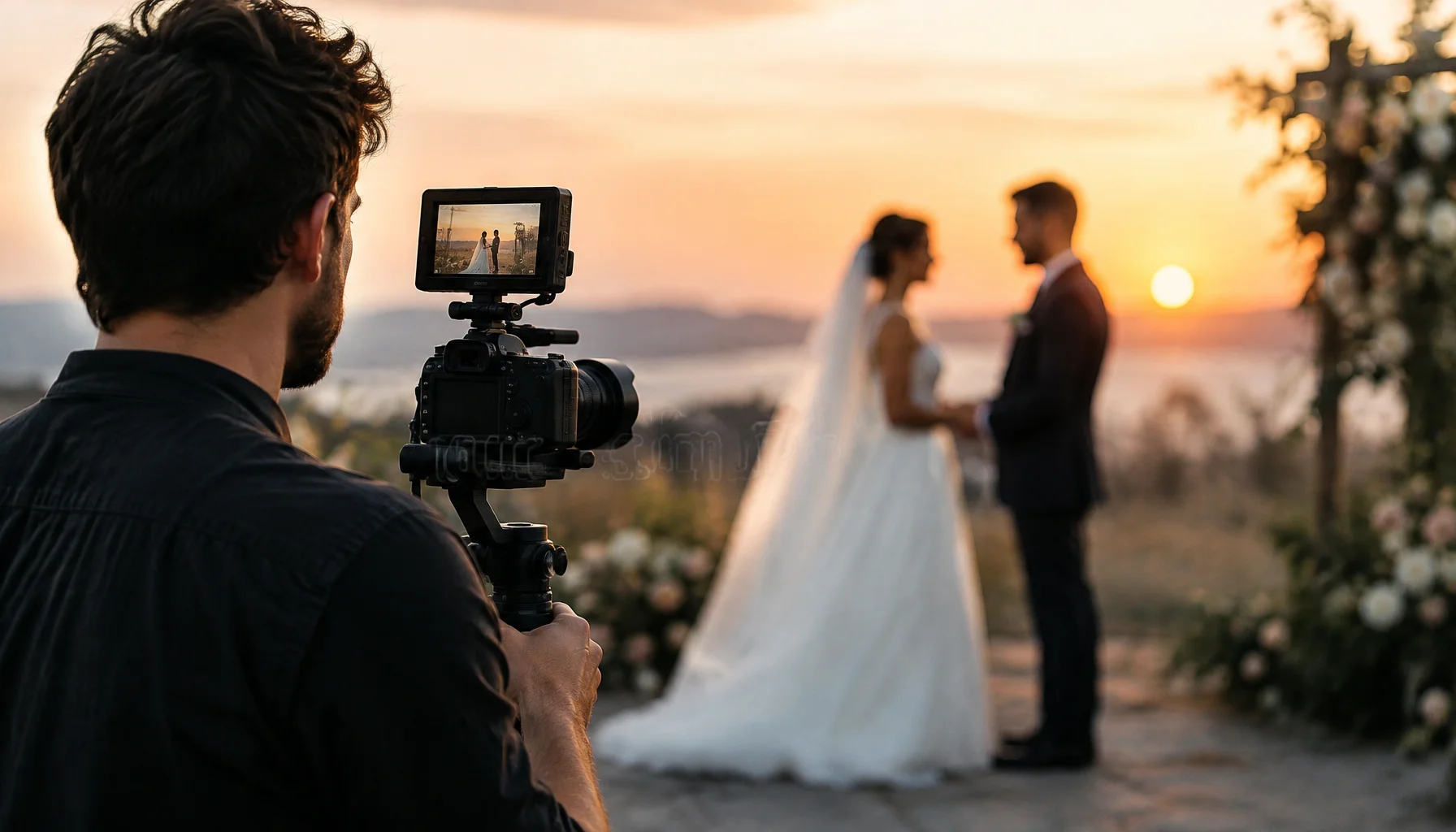
A photograph can preserve the instant in which something happened. Film can preserve the seconds around it: the breath before a vow, the movement across a room, a laugh arriving from outside the frame, the hesitation before someone answers, the way applause grows and then falls away. That difference is why a wedding film should not be planned as a moving photo album. It is a record of time — and an interpretation of that time once an editor begins deciding what the viewer will see, hear and remember.
The difference begins with time, not resolution
Couples are often shown wedding-film packages through technical labels: 4K, drone footage, cinematic color, multiple cameras, vertical teaser, documentary cut. Those details matter, but none of them answers the first question: what kind of memory is the film meant to preserve?
A still photograph can make one fraction of a second carry enormous weight. Film works differently. It can preserve the approach to a moment, the moment itself and the release afterward. A hand enters the frame. Someone looks away. A room becomes quiet. A sentence takes longer than expected. Meaning is often carried by that duration.
That is why the best starting point is not “Which camera package do we need?” It is “What do we want to be able to return to later: the facts of the day, the voices, the atmosphere, a crafted story, or some combination of all four?”
Four different things couples may mean by “wedding film”
Choose the film by the memory job it needs to do
| Documentary record | Narrative short film | Same-day edit | Experimental / creative film | |
|---|---|---|---|---|
| Main goal | Preserve events, vows, speeches and chronology with minimal compression | Shape the day into a concise emotional story | Turn footage from the day into a film that becomes part of the celebration itself | Use the wedding as material for a more interpretive or stylized moving-image work |
| Typical structure | Mostly chronological or event-based | Reordered around themes, voices, emotional beats and visual motifs | Very short, rapidly assembled arc using material available before the screening | May be nonlinear, staged, composited, reconstructed or partly generated |
| Role of sound | Long-form intelligibility matters | Vows, speeches, ambient sound and music are selected for story | Sound must be captured and processed quickly enough for immediate use | Sound may be heavily designed or partly detached from documentary chronology |
| Editorial freedom | Lower: the record should remain easy to understand | Medium to high: chronology can be compressed and rearranged | High pressure rather than unlimited freedom: speed constrains choices | Highest, provided synthetic or reconstructed material is clearly understood |
| Best fit | Couples who want a durable record of what was actually said and done | Couples who want a film they will repeatedly watch as a story | Couples who want the film premiere to become part of the reception experience | Couples who explicitly want experimentation beyond straightforward documentation |
Motion preserves the seconds around the moment
A wedding contains many events that are visually modest but temporally rich. A parent may spend several seconds deciding whether to step forward. A guest may begin laughing before the couple notices why. The room may stay completely still after a difficult or beautiful sentence.
Those intervals are difficult to reduce to a single frame because their meaning lies partly in change. Film can hold the progression: before, during and after. This is where wedding cinema begins to overlap with the Loving Rocks idea of Silence — not because the film needs to be quiet, but because pauses and withheld reactions are themselves part of what happened.
The pause before the words can matter as much as the words
A tightly cut highlight film can accidentally remove exactly these intervals because pauses look inefficient on a timeline. Yet some of the strongest wedding material is structurally “empty”: a breath, a glance, a few seconds of room tone, the moment before applause begins.
Sound is not an accessory to the picture
A beautiful wedding film with weak sound can lose material that cannot be recreated later. Vows, speeches, private remarks, room reactions and the physical character of a voice are not merely information attached to the image. They are part of the memory.
This is especially important because the camera that has the best angle is not always the device that should carry the final sound. Professional wedding-film workflows may therefore combine camera audio with separate microphones or recorders and synchronize those sources in post-production.
The Wedding Film Memory Stack
One way to understand a finished wedding film is to separate what the production records from what the edit later adds. The layers below can coexist in the same film, but they should not be confused.
| Layer | What it preserves or adds | Examples |
|---|---|---|
| Event layer | Observable material from the day | Who was present, what happened, where people moved, what was said |
| Presence layer | The sensory continuity around the event | Voice, breath, movement, room tone, ambient sound, duration, reaction |
| Sequence layer | Meaning created by order and juxtaposition | A vow played over preparation footage; a later speech placed before the ceremony in the edit |
| Interpretation layer | The filmmaker's aesthetic and narrative treatment | Music, pacing, color grade, slow motion, sound design, selective emphasis |
| Creative layer | Material that goes beyond straightforward documentation | Staged inserts, composites, reconstructed scenes, generated imagery or deliberately fictionalized transitions |
How a multi-camera wedding story is actually built
When several cameras and separate audio sources cover the same moment, the editor first needs a common temporal structure. Current Adobe Premiere documentation describes multi-camera source sequences that can synchronize footage using timecode, audio, clip markers or in/out points. Separate field audio can be brought into the same synchronization workflow.
That technical capability matters because wedding coverage is full of non-repeatable events. One camera can stay wide while another isolates faces or reactions. Separate audio can protect intelligibility even when the visually strongest camera is far from the speaker.
High-resolution footage also creates a practical editing problem: the best capture format is not always the fastest format to cut. Adobe's current proxy workflow keeps high-resolution originals while creating lighter working copies for smoother editing, then returns to the original media for final output. That kind of separation is especially useful when a project contains many cameras or must be edited under time pressure.
The Film Brief Flow: from memory goal to final master
Plan the film before the cameras start recording
A same-day edit changes the wedding itself
A same-day edit is not simply a wedding film with an unusually short delivery time. Once the film is screened during the reception, it becomes part of the event it is documenting. Guests watch moments from a day that is still unfolding. The wedding briefly becomes its own premiere.
This format is commercially real today. Piña Colada in Barcelona, for example, currently describes a same-day edit workflow in which footage is edited and premiered during the reception, supported by an on-site editing station and a technical team. That is one provider's implementation, not an industry-wide specification, but it demonstrates the production model clearly.
It also changes the emotional function of the film. A conventional wedding film is usually watched after the day has become memory. A same-day edit is watched before that transition is complete. The audience is still inside the event.
Cinematic does not have to mean less truthful
Color grading, music, slow motion, selective focus, nonlinear editing and sound design can make a wedding film highly cinematic without inventing a different wedding. Interpretation becomes more sensitive when the edit changes what a viewer could reasonably believe happened.
A speech recorded at dinner can legitimately play over images from the morning if the film is clearly functioning as a narrative montage. A generated shot that appears to document a location, person or event that was never captured is a different kind of intervention.
Loving Rocks already uses a similar distinction in photography: presentation can be creative while material alteration needs a clearer boundary. Film adds another variable because even authentic footage can change meaning through sequence and sound.
What to ask before booking a wedding filmmaker
- Do you deliver a short highlight film, a documentary ceremony/speech edit, or both?
- How do you record vows and speeches when the camera is not close to the speaker?
- Do you use one filmmaker, two filmmakers, or a larger team for simultaneous moments?
- How do you synchronize multiple cameras and separate audio?
- Can we see complete films, not only trailers or social-media highlights?
- How much can chronology be rearranged in the final edit?
- Do you ever stage, reconstruct or recreate moments after they happen?
- Do you use generative AI or synthetic video in any normal part of the delivered wedding film?
- If we want a same-day edit, who edits while the rest of the wedding is still being filmed?
- Which final versions do we receive: highlight, full ceremony, speeches, teaser, vertical cuts, documentary master?
- How long are final files kept, and is re-delivery available if our own archive fails?
The deliverable should match what you want to remember
| Memory need | Useful deliverable | Why |
|---|---|---|
| Relive vows without compression | Full ceremony or dedicated vows edit | Preserves wording, pauses, voice and sequence rather than only selected lines |
| Keep family speeches intact | Full speech edit with clean audio | Protects voices and stories that may matter more with time |
| Rewatch the day as a story | Short narrative highlight film | Compresses many hours into an emotionally coherent piece that is easy to revisit |
| See more of what actually happened | Longer documentary cut | Retains more chronology, interactions and transitional material |
| Make the film part of the reception | Same-day edit | Turns captured material into a shared guest experience before the event is over |
| Share quickly on social platforms | Short teaser / vertical derivative | Useful for immediate sharing, but should not replace the durable master |
Where Film sits inside Loving Rocks
Film belongs in Media as a discovery surface, but its editorial meaning crosses several of the portal's deeper paths. It belongs to Stories because editing turns lived material into narrative. It belongs to Imprints because voices, gestures and sequences can remain active long after the day ends. It touches Silence because the unspoken seconds around a moment can be as revealing as the spoken line.
That is also why Film should eventually connect naturally to Wedding Film Showcase and Production Showcase content. A strong provider feature should not merely show a reel. It should explain the brief, capture strategy, sound plan, edit choices, constraints and final experience so that a reader can understand why the film feels the way it does.
What this article does not decide for you
There is no universal best wedding-film format. A couple who wants every ceremony word may value a documentary cut more than a highly polished five-minute film. Another couple may never watch a two-hour record but may return to a short narrative film for decades.
The right level of cinematic interpretation also depends on trust. Some people want an editor to reshape the day boldly. Others want the film to remain close to chronology and observable events. Neither preference is inherently more sophisticated.
Rights to music, privacy, venue recording rules, drone operation and contractual delivery terms can also affect production, but those are separate legal and licensing questions that vary by jurisdiction and agreement and should be checked for the actual wedding.
The best wedding film knows what it is trying to preserve
A wedding film becomes valuable when the form matches the memory. If the priority is testimony, protect the words. If it is presence, protect the sound and duration around the moments. If it is narrative, give the editor room to shape sequence. If it is experimentation, make the creative boundary explicit.
Years later, the most technically perfect shot may not be the reason someone presses play again. It may be a voice that no longer sounds familiar in daily life, a room becoming quiet, the movement before an embrace, or a few seconds the editor was wise enough not to cut.
Glossary
Key wedding-film terms
- Documentary cut
- A longer edit designed primarily to preserve events, speeches, vows or chronology rather than compress the day into a short narrative.
- Narrative wedding film
- A shorter, more interpretive edit that may reorder footage and audio to create an emotional story rather than reproduce the day strictly in sequence.
- Same-day edit
- A short wedding film assembled during the celebration and screened before the event is over.
- Multicam
- A production and editing workflow that uses footage from multiple camera angles covering the same event or time period.
- Timecode
- Time information recorded with media and used in production workflows to identify or synchronize moments across clips and recording devices.
- Proxy
- A lighter working copy of high-resolution footage used to make editing more efficient while the original media remains available for final output.
- Room tone
- The ambient sound of a location when no dominant action or speech is occurring; it helps preserve the acoustic character and continuity of a scene.
Primary workflow sources and real implementation
Adobe Premiere — Create a Multi-Camera Source SequenceCurrent Adobe documentation for synchronizing and editing footage from multiple cameras using timecode, audio, markers and other synchronization methods.
Adobe Premiere — Ingest and Proxy WorkflowCurrent Adobe documentation explaining how high-resolution originals and lower-resolution proxy media can be used together in an editing workflow.
Piña Colada — Same Day Edit Wedding FilmA current commercial example from Barcelona describing an on-site wedding-film workflow edited and premiered during the reception.
Loving Rocks — What Wedding Guests Actually Hear When Vows Are SpokenInternal editorial context on voice, rhythm, hesitation and the experience of spoken vows.
Loving Rocks — AI-Edited Wedding Photos in 2026Internal documentary-boundary framework for distinguishing visual interpretation from material alteration.
Related Articles
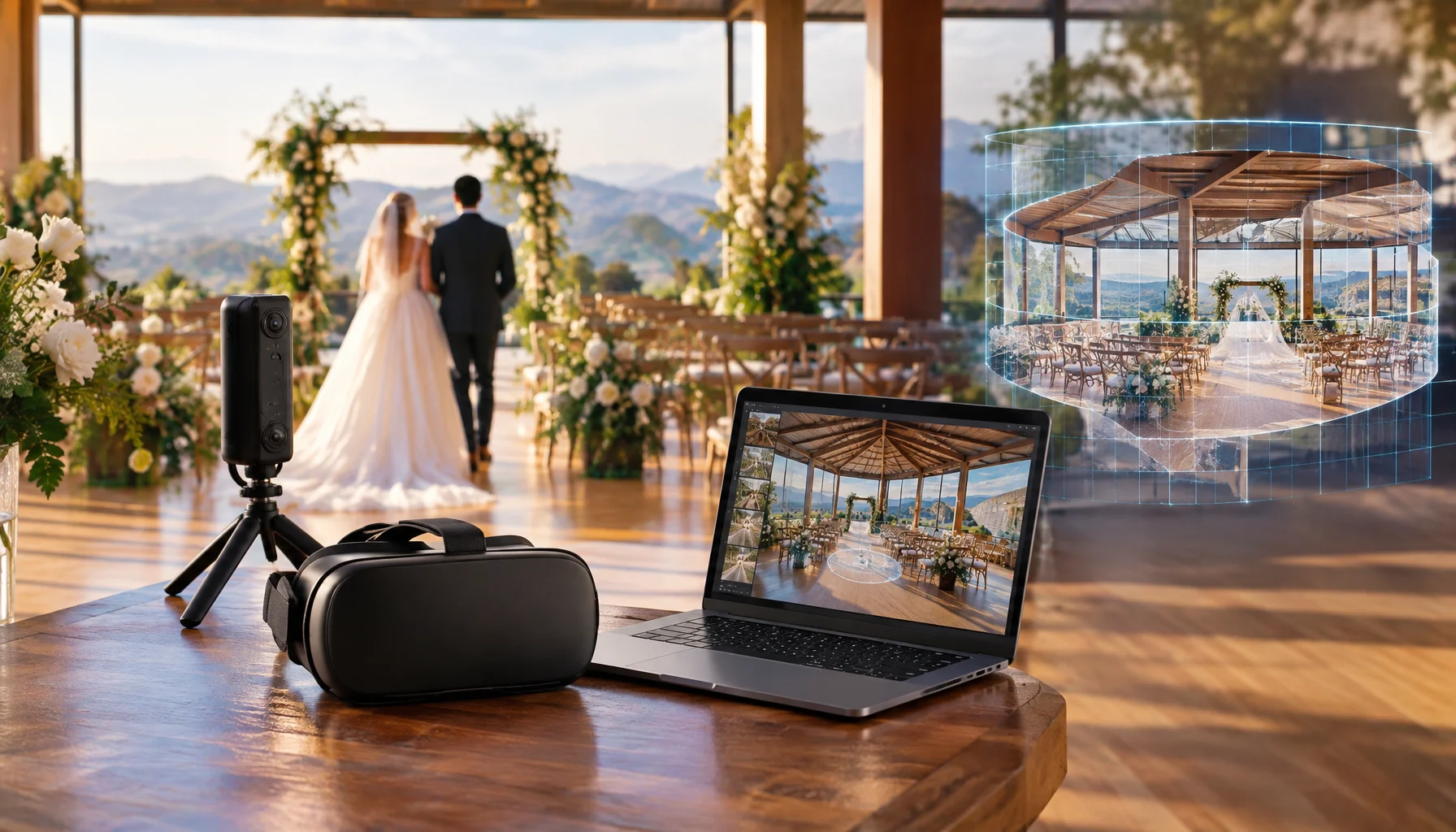
Can You Return to a Wedding? Spatial Video, 3D Venues and the New Memory Layer
Wedding media has traditionally preserved a view of the day. Spatial video, 3D capture, photogrammetry, 180° VR and volumetric video begin asking a different question: can part of the wedding be preserved as a space you can later revisit? This guide separates what is already practical from what remains complex, expensive or experimental.
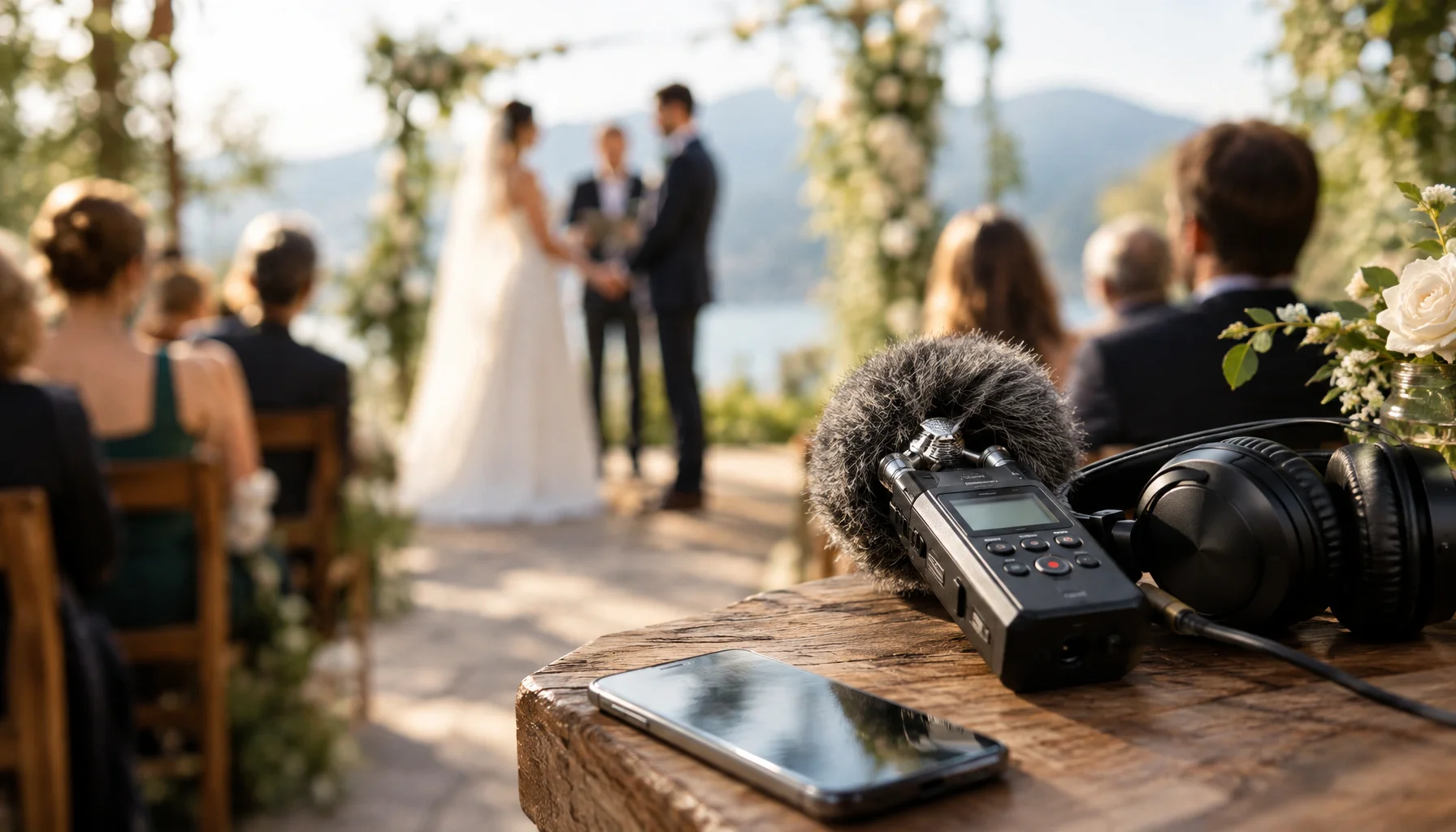
The Wedding You Can Hear Again: Voice, Room Tone and the Audio Memory of a Day
A wedding is remembered through images, but voices disappear differently. Vows, laughter, pauses, speeches, room tone and messages from guests can become an audio archive of people as they actually sounded on one particular day. This guide explores what is worth recording, how wedding audio is captured, and how to preserve it as more than an accessory to film.
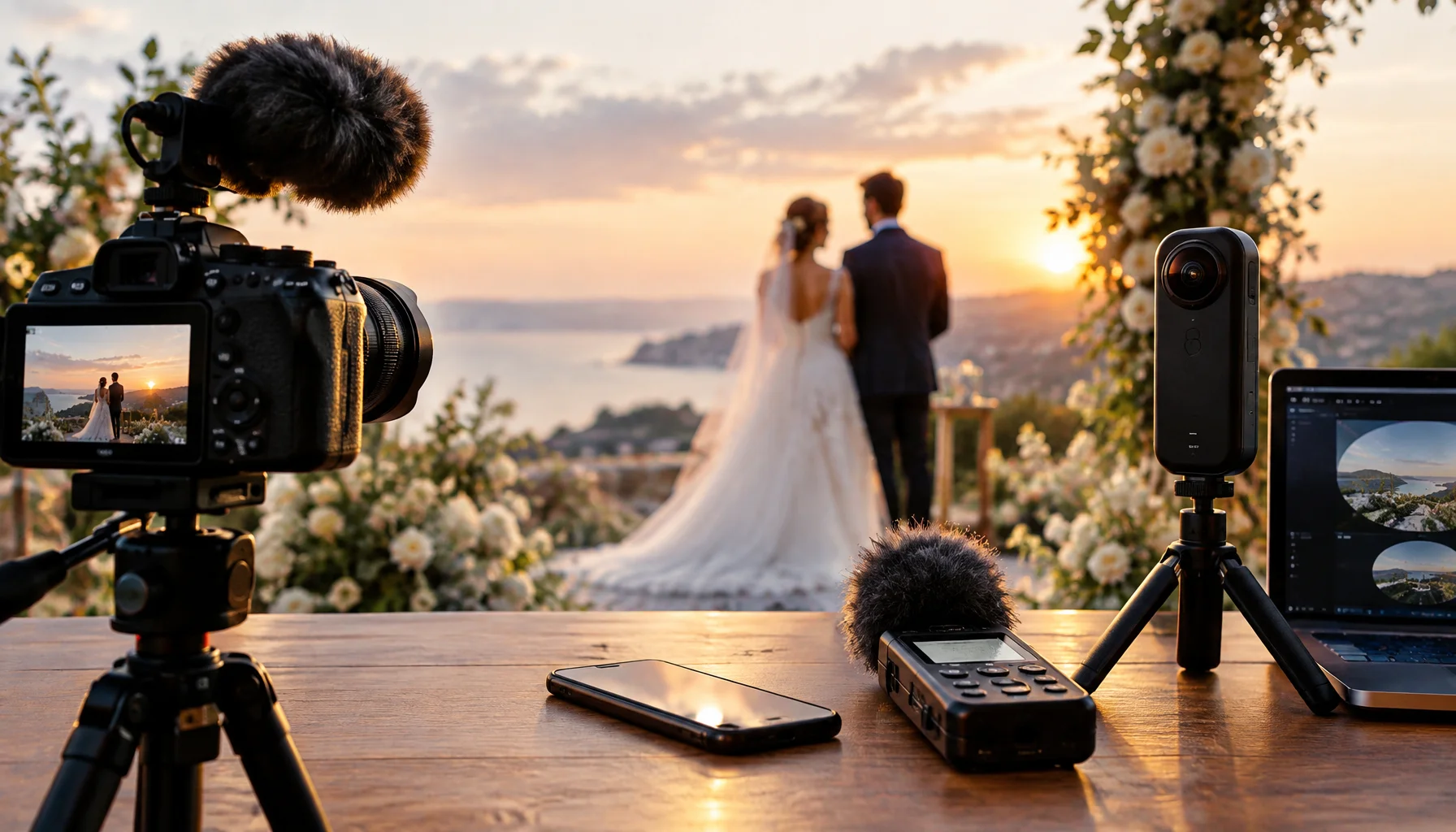
The Wedding Beyond the Photograph: What Film, Sound and Spatial Media Let Us Keep
A wedding no longer has to survive only as a set of photographs. Film can preserve movement, audio can retain voices and atmosphere, and spatial media can begin to record the shape of a place itself. The more interesting question is not which format is newest, but what each medium is capable of carrying forward.