
The Wedding You Can Hear Again: Voice, Room Tone and the Audio Memory of a Day
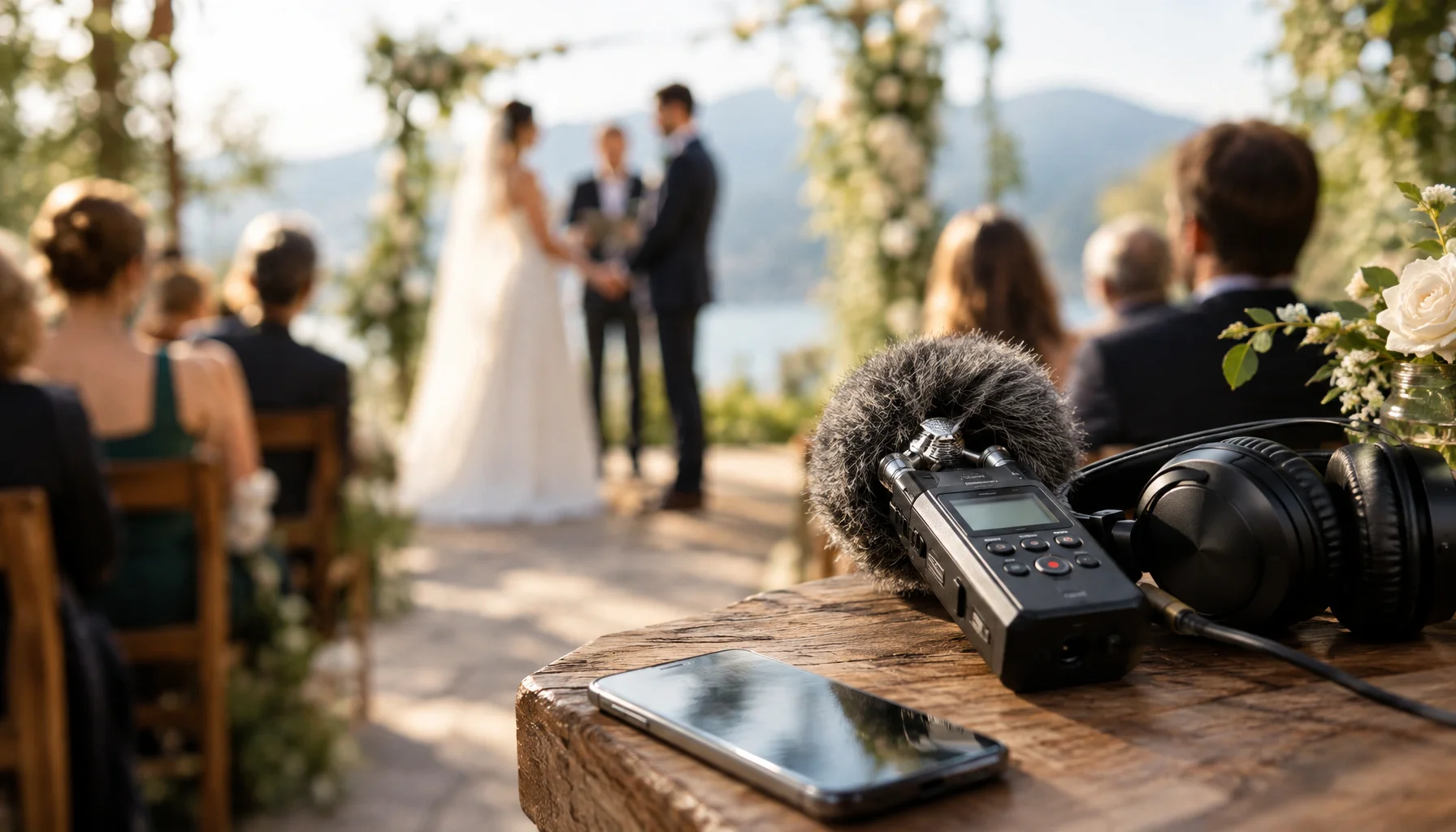
Years after a wedding, people may still remember what someone looked like. Remembering exactly how they sounded is harder. The pitch of a parent's voice, the rhythm of a grandparent's laugh, the way a partner paused before a vow, the background murmur of a room full of familiar people — these details often disappear quietly. Audio can preserve them.
That makes wedding audio more than the soundtrack beneath a film. It can be its own memory medium: documentary evidence, emotional atmosphere, oral history and sometimes the only surviving recording of a voice at a particular moment in someone's life.
Wedding audio is not the same thing as wedding music
Music shapes a wedding while it is happening. Wedding audio, in the sense explored here, asks a different question: what from the real acoustic life of the day should still be available later?
That can include vows and speeches, but the useful archive is wider. A flower girl asking a question before the ceremony, glasses moving across a dinner table, cousins laughing outside the reception, a musician warming up, footsteps in a hallway or several seconds of complete stillness can carry information that no playlist contains.
The value is not necessarily apparent on the wedding day. Audio changes with time because voices themselves change. The ordinary recording can become extraordinary later.
The Wedding Sound Memory Stack
A useful way to plan wedding audio is to separate five layers that are often mixed together during production.
| Layer | What it preserves | Examples |
|---|---|---|
| Words | The literal information that was spoken | Vows, speeches, readings, messages, announcements |
| Voice | The individual human sound carrying those words | Accent, age, breath, laughter, hesitation, vocal rhythm |
| Space | How the place itself sounded | Room reflections, church acoustics, outdoor ambience, crowd murmur |
| Event | Sound produced by things actually happening | Applause, glasses, doors, footsteps, music performance, dancing |
| Silence | The absence or reduction of sound around a meaningful moment | Pause before an answer, room settling before vows, seconds after a speech |
Voice may become the most valuable layer
Written messages are durable because they turn language into an object. Recorded voice preserves a different kind of presence. The same sentence can sound playful, nervous, formal, exhausted, affectionate or almost impossible to finish.
This is where Audio belongs naturally inside Imprints. A voice recording is not only information about what happened. It can become an emotional trace that remains active long after the event itself.
It also belongs to Stories. People rarely speak into a microphone exactly as they write in a guestbook. They wander, remember, interrupt themselves, laugh, address people who are not standing next to them and sometimes tell a story nobody expected.
Vows need an audio plan, not just a camera
A camera can have the perfect view of a ceremony and still be in the wrong place to capture clear speech. Distance, wind, room reflections, guests moving nearby and amplified venue sound can all change what reaches the camera microphone.
For that reason, professional production may record sound separately from the camera and synchronize it later. Current editing systems explicitly support workflows in which separately recorded audio is aligned with video using waveform audio, markers or timecode.
The practical question for a couple is therefore not whether the filmmaker has a good microphone. It is whether important speech has a deliberate capture path and whether there is redundancy when the moment cannot be repeated.
Do not edit every silence away
Audio editing naturally removes dead time, mistakes and unnecessary gaps. But silence is not always dead time.
A pause before an answer can reveal hesitation or emotion. Several quiet seconds after a reading can show that the room needed time before moving on. A breath before someone says a name can matter more than the sentence that follows.
That gives Audio a natural bridge into Silence. The objective is not to romanticize every gap. It is to recognize that removing all acoustic emptiness can also remove part of the timing through which the moment was experienced.
Room tone can make a memory feel physically located
Every place has an acoustic signature. A small stone church, open field, hotel ballroom, restaurant, garden and family home do not merely look different. They respond differently to voices, movement and music.
Audio production often uses the term room tone for the ambient sound of a location without dominant foreground action. In editing it helps create continuity. As memory, it can do something more subtle: it returns a voice to the space in which it existed.
The audio guestbook turns guests into an oral archive
One of the clearest commercial expressions of wedding audio is the audio guestbook. Instead of signing a page, guests pick up a telephone or recording device and leave a spoken message.
This is no longer only a conceptual wedding idea. After The Tone, for example, currently rents restored rotary-style phones for weddings and events. Guests hear a prompt and leave voicemail-style recordings, which are later delivered as digital audio; the company also offers physical keepsake options.
The important idea is larger than the telephone aesthetic. The device creates a small private recording space inside a public celebration. That changes what guests may say.
Written guestbook, audio guestbook or video message booth?
Each medium preserves a different kind of presence
| Written guestbook | Audio guestbook | Video message booth | |
|---|---|---|---|
| Best at preserving | Words, handwriting and physical marks | Voice, timing, laughter and spontaneous storytelling | Voice, facial expression, gesture and appearance |
| Guest performance pressure | Low to medium | Medium; feels private once the receiver is lifted | Often highest because the guest knows appearance is being recorded |
| How it is revisited | Open and browse | Listen sequentially or by individual message | Watch, usually with greater attention demand |
| Unique emotional signal | Handwriting | Voice | Physical presence |
The prompt changes the archive you receive
“Leave us a message” usually produces congratulations. A more deliberate prompt can produce memories.
- Tell us something about today that you do not want us to forget.
- Tell us a story about one of us that the other person may not know.
- What did you notice today that surprised you?
- What do you hope we will still remember when we listen to this in twenty years?
- Say your name first so future listeners know whose voice they are hearing.
- If you knew us before we knew each other, tell us what we were like then.
The difference is editorial. A generic instruction collects reactions. A carefully designed prompt can collect oral history.
The Audio Capture Map
Decide what deserves dedicated recording
Why 32-bit float appears in modern field recording
Wedding sound is unpredictable. Someone can whisper during a reading and a room can erupt into applause seconds later. That large difference in level is one reason modern field recorders increasingly use 32-bit float recording.
Current recorders such as Zoom's M2 use 32-bit float recording specifically to provide a wide working range without the same conventional input-gain workflow used by fixed-point recording.
That does not make audio indestructible. Poor microphone position, wind, clothing noise, radio interference, an overloaded analogue stage, a disconnected cable or a speaker who was never properly covered cannot be repaired by file bit depth alone.
Good wedding audio may live outside the camera
Separate recording is useful because the ideal microphone position and ideal camera position are often different.
Modern post-production workflows are designed for this. Adobe Premiere, for example, can synchronize separately recorded audio and video and can use shared audio or timecode as synchronization information in multi-camera workflows.
For couples, the engineering detail matters mainly as evidence of planning. A filmmaker who treats sound as a separate production system can choose the microphone according to the voice rather than forcing every important memory through whatever happens to be attached to the camera.
Do not let the only copy of a voice become a messaging-app file
Convenient listening copies and preservation masters serve different purposes. A compressed file is useful for phones, websites and quick sharing. A high-quality master should remain available separately.
Professional preservation practice provides a useful reference point. The Library of Congress uses and prefers Broadcast WAVE with linear PCM for archival mono and stereo audio in relevant preservation workflows. A wedding archive does not need to imitate a national archive, but the underlying principle transfers well: keep a durable, non-lossy master and create convenience copies from it.
The Voice Archive Flow
From wedding recording to durable voice archive
The person's name may matter more than the codec
Technical preservation is only half of an archive. Twenty years later, a folder called “guestbook-final-03.wav” may be perfectly intact and still fail as memory because nobody knows who speaks at 18 minutes and 42 seconds.
Names, relationships, date, location and simple descriptions can make the material legible to future family members who were not present when it was recorded.
| Archive element | Useful context |
|---|---|
| Vows | Names, ceremony date, location |
| Speech | Speaker name, relationship, part of reception |
| Guest message | Speaker name where known and message order |
| Family interview | Names, relationship, question or prompt |
| Ambient recording | Location and approximate part of the day |
| Live music | Performer, song or performance context where rights and documentation allow |
The next step is not louder audio. It is spatial memory
Conventional wedding audio is usually designed around intelligible voices and a stereo listening experience. More experimental capture can preserve directional and spatial information: not only that applause happened, but the sense that it surrounded the listener; not only that music played, but where it existed in relation to the room.
That changes the objective from recording sound to reconstructing presence. It also introduces more demanding capture, reproduction and delivery questions, which is why spatial sound belongs naturally at the boundary between Audio and the next Loving Rocks surface: Immersive Media.
What to ask before commissioning wedding audio
- Which voices or events receive dedicated microphones rather than camera audio alone?
- What is the backup plan for vows and speeches?
- Do you record separate ambience or room tone?
- How is external audio synchronized with film?
- If an audio guestbook is used, how are individual messages delivered and identified?
- Can we keep a high-quality lossless master in addition to easy listening copies?
- What file formats will we actually receive?
- How long does the provider retain source recordings after delivery?
- Can names or message metadata be included so the archive remains understandable later?
- If aggressive noise reduction or AI voice cleanup is used, is an untreated or minimally processed master also retained?
AI cleanup creates another documentary boundary
Modern audio tools can suppress noise, isolate speech and make difficult recordings easier to hear. That can be extremely useful for weddings.
But there is a conceptual difference between restoring intelligibility and synthesizing or materially changing a voice. If a future workflow begins reconstructing missing syllables, replacing words or generating speech that was never captured, the result should no longer be treated as straightforward documentary restoration.
Where Audio sits inside Loving Rocks
Audio is the primary category of this content surface, with Media as its wider home. Its strongest editorial connection is Imprints: sound can remain active long after the day that produced it.
It also crosses Stories because voices tell stories differently from text, and Silence because pauses, breath and acoustic emptiness can carry meaning rather than simply waiting to be edited out.
What an Audio Showcase should eventually prove
A future Loving Rocks Audio Showcase should do more than display a microphone or guestbook phone. It should demonstrate the complete memory path: what needed to be preserved, how it was captured, what technical problems existed, how the material was edited and what the couple finally received.
Questions couples often reach only after the wedding
Wedding audio and voice archives
Is camera audio enough for wedding vows?
What is an audio guestbook?
Does 32-bit float mean wedding audio cannot be ruined?
Which audio file should we keep long term?
Should silence be removed from vows and speeches?
Glossary
Key wedding-audio terms
- Audio guestbook
- A guestbook format in which guests leave recorded spoken messages rather than, or in addition to, written entries.
- Room tone
- The ambient acoustic sound of a location without dominant foreground speech or action, useful for editing continuity and for preserving a sense of place.
- 32-bit float
- A digital audio recording format with an extremely wide numerical dynamic range, used by modern field recorders to make unpredictable recording levels easier to manage.
- Double-system sound
- A production workflow in which audio is recorded separately from the camera and synchronized with the video during post-production.
- Lossless master
- A high-quality audio master stored without lossy perceptual compression and retained as the source for future listening or derivative files.
- Broadcast WAVE
- A WAVE-based professional audio format that adds broadcast metadata and is used in archival and production workflows.
- Voice archive
- An organized collection of voice recordings preserved with enough context to identify speakers, occasions and meaning later.
- Spatial audio
- Audio designed to preserve or reproduce directional and spatial relationships around the listener rather than only conventional left-right stereo placement.
The voice is part of what remains
Wedding media usually begins with the visible. Audio reminds us that memory is not only visual. People are also remembered through cadence, accent, laughter, imperfect sentences, breath and the sound they make when they are trying not to cry.
The most important wedding recording may eventually be neither the first dance song nor the polished film soundtrack. It may be forty seconds of an ordinary person speaking in their ordinary voice, before anyone understood how valuable that would become.
Primary workflow sources and real implementation
After The Tone — Audio Guest BookCurrent commercial implementation of a telephone-style audio guestbook for weddings and events, with recorded messages delivered after the event.
Zoom M2 — Operation ManualManufacturer documentation for a current 32-bit float field recorder, including recording behavior and supported sample rates.
Adobe Premiere — Synchronize Audio and VideoCurrent Adobe documentation for synchronizing separately recorded audio and video in post-production.
Library of Congress — Broadcast WAVE with LPCMLibrary of Congress format guidance describing Broadcast WAVE with LPCM and its use as an archival master format for mono and stereo audio preservation.
Loving Rocks — What Wedding Guests Actually Hear When Vows Are SpokenInternal editorial context on vows as voice, rhythm, hesitation and shared acoustic experience.
Related Articles
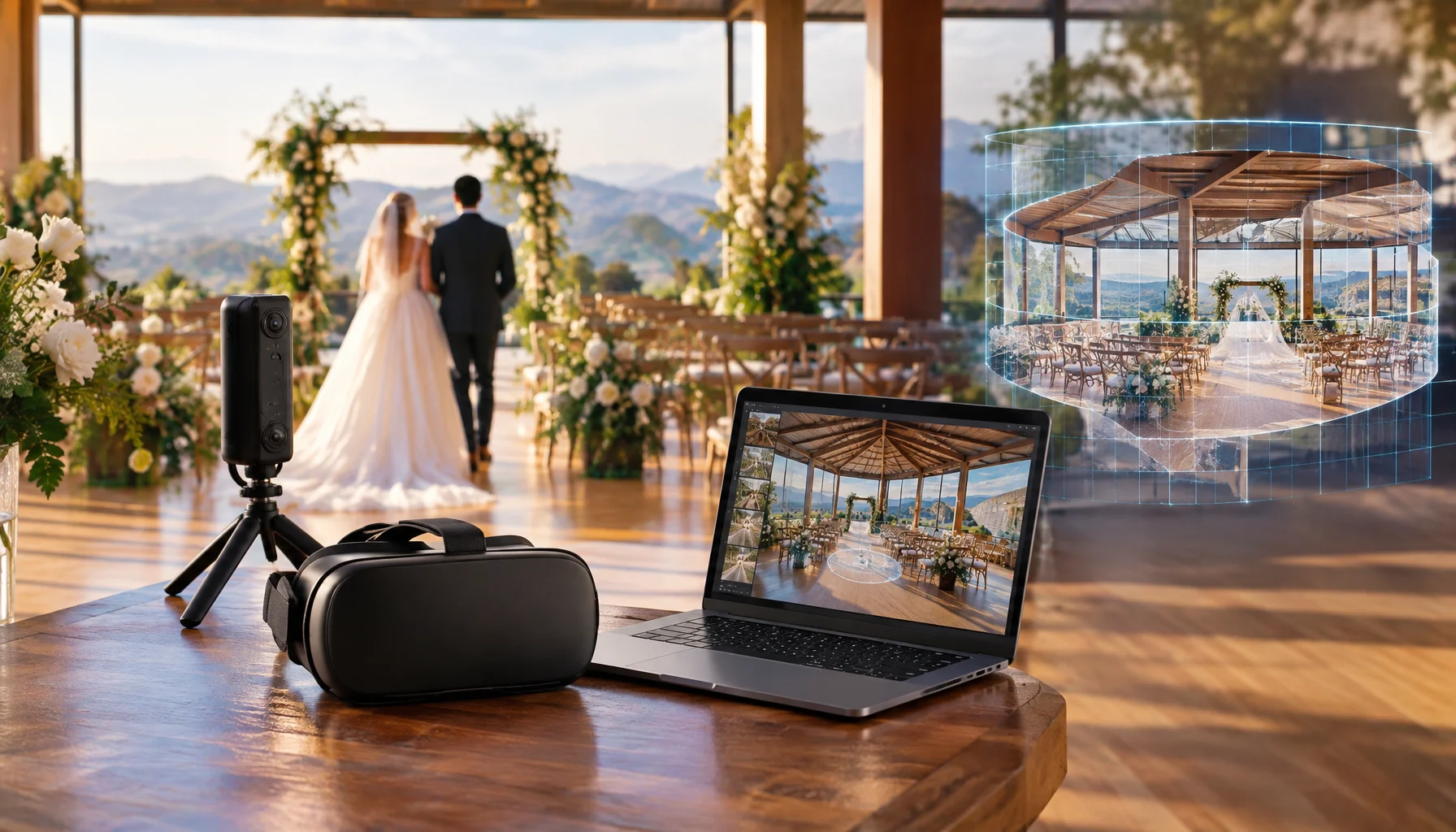
Can You Return to a Wedding? Spatial Video, 3D Venues and the New Memory Layer
Wedding media has traditionally preserved a view of the day. Spatial video, 3D capture, photogrammetry, 180° VR and volumetric video begin asking a different question: can part of the wedding be preserved as a space you can later revisit? This guide separates what is already practical from what remains complex, expensive or experimental.
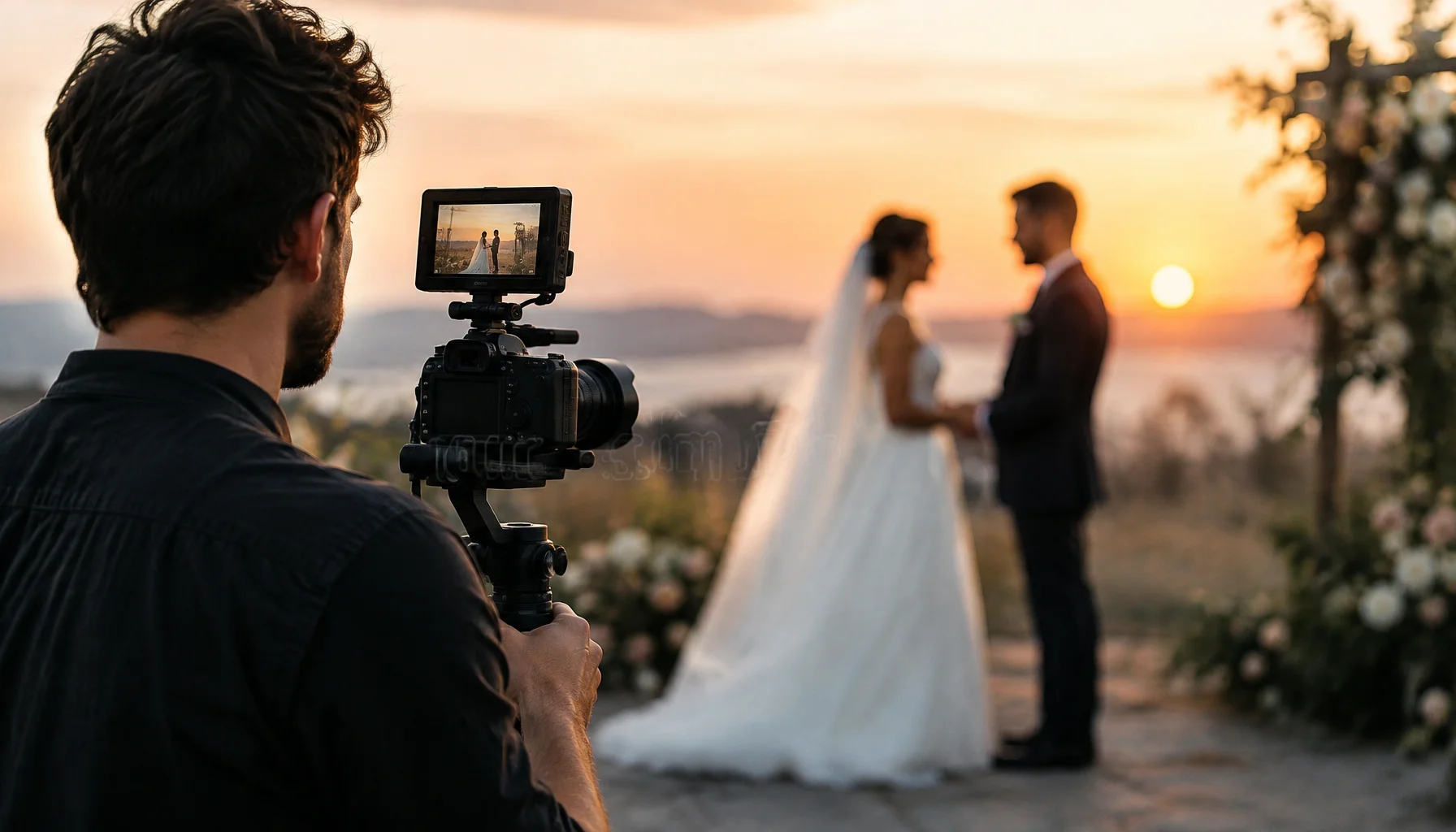
When a Wedding Becomes a Film: What Motion, Sound and Sequence Add to Memory
Wedding film preserves more than moving images. It can hold voice, pauses, movement, chronology and atmosphere — while editing also shapes how the day will later be remembered. This guide explores documentary, narrative, same-day and experimental wedding-film formats, how they are produced, and what couples should decide before cameras roll.
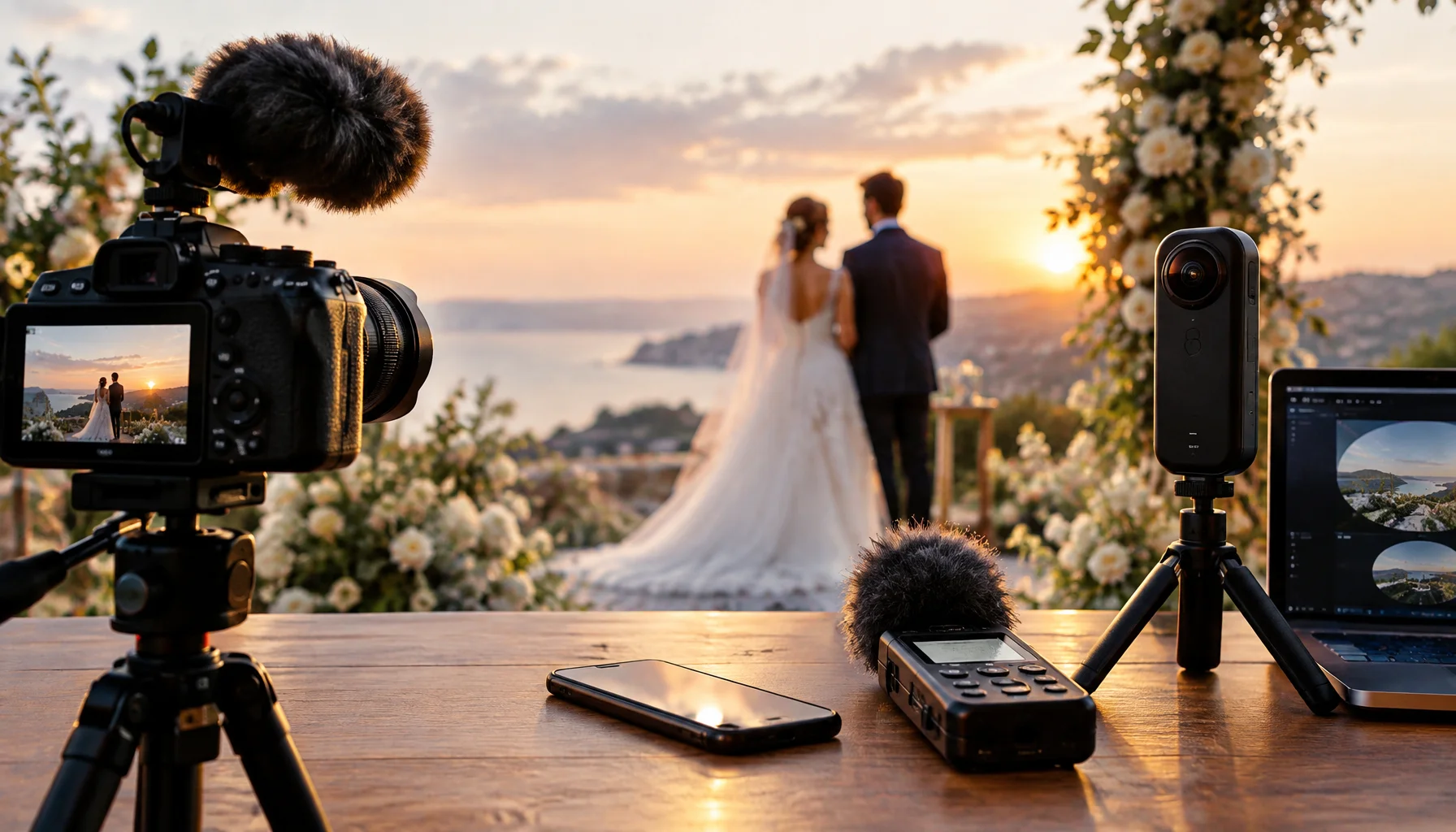
The Wedding Beyond the Photograph: What Film, Sound and Spatial Media Let Us Keep
A wedding no longer has to survive only as a set of photographs. Film can preserve movement, audio can retain voices and atmosphere, and spatial media can begin to record the shape of a place itself. The more interesting question is not which format is newest, but what each medium is capable of carrying forward.