
Should a Robot Serve Your Wedding? Where Automation Helps — and Where Humans Still Matter
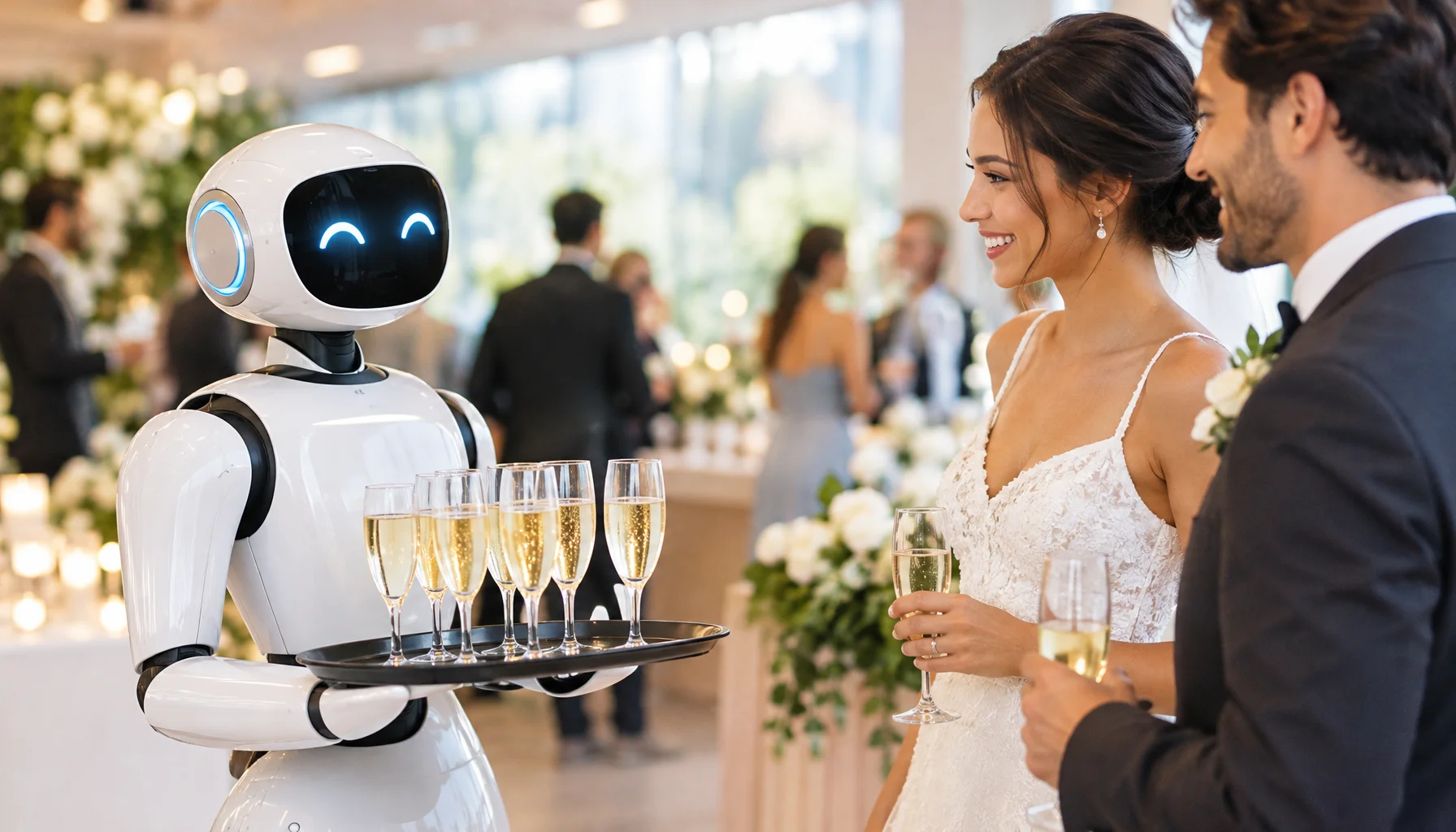
A robot carrying champagne through a wedding reception is no longer science fiction. Neither is a robotic bartender, an autonomous service cart, a humanoid greeting guests or a mobile screen carrying the face of someone who could not travel.
The harder question is whether any of those machines improve the wedding.
Weddings are unusually difficult environments for automation because they combine hospitality, emotion, irregular movement, children, formal rituals, alcohol, furniture, changing room layouts and people who are not interested in behaving like predictable objects in a logistics simulation.
Wedding robots already exist — but they do very different jobs
The phrase wedding robot can describe several technologies that have almost nothing in common operationally.
A tray-carrying service robot is primarily a logistics machine. A cocktail robot automates preparation or becomes a bar performance. A humanoid robot may function mainly as entertainment. A telepresence robot can act as a movable communication endpoint for a remote participant.
The Wedding Robotics Role Map
| Logistics | Service automation | Presence | Performance | |
|---|---|---|---|---|
| Primary job | Move objects | Prepare or deliver a repeatable service | Connect a person to the event | Create attention or entertainment |
| Examples | Tray transport, supplies, internal delivery | Robot bartender, coffee robot, automated serving | Telepresence robot, mobile video communication | Humanoid greeting, dancing, scripted interaction |
| Strongest value | Reduce repetitive carrying | Consistency and throughput | Reduce physical distance | Novelty and memorable interaction |
| Main wedding risk | Robot becomes an obstacle | Hospitality becomes impersonal | Remote guest becomes a device rather than a participant | The machine competes with the wedding for attention |
Service robots are strongest when they support staff rather than impersonate them
Modern hospitality robots can already navigate mapped environments and transport food, drinks and other items between defined locations.
PUDU's BellaBot Pro, for example, is a current commercial service robot designed around autonomous delivery in catering and hospitality. It carries multiple trays and combines navigation with obstacle detection and interactive service functions.
The interesting wedding application is not necessarily replacing a waiter. It is separating transport from hospitality.
Carrying a tray and hosting a guest are not the same task
Hospitality contains both physical logistics and social judgment. Those two layers are often bundled into one job because the same person traditionally performs both.
| Task | Automation potential | Human value |
|---|---|---|
| Move trays from kitchen to service point | High | Relatively low when no guest interaction is required |
| Return empty dishes | High in suitable environments | Low |
| Bring repetitive supplies | High | Low |
| Explain ingredients and dietary concerns | Possible technically | High judgment and trust value |
| Notice that a guest needs help before being asked | Limited | High |
| Handle an unexpected spill, child or blocked route | Limited and environment-dependent | High |
| Read whether a table wants attention or privacy | Poor automation target | Very high |
| Respond gracefully to an emotional or unusual situation | Poor automation target | Very high |
A wedding floor is a harder navigation problem than an empty restaurant
Service robots work best when routes, destinations and obstacles are sufficiently predictable. Weddings become less predictable as the evening progresses.
Chairs move. Guests stand in aisles. Children run across routes. Bags appear beside tables. Photographers step backward while looking through cameras. A dance floor changes from empty space to a dense moving crowd in minutes.
Some wedding zones are much better automation targets than others
Where autonomous movement makes more or less sense
| Good candidate | Conditional | Poor candidate | |
|---|---|---|---|
| Environment | Wide predictable service routes | Dining room with controlled traffic | Dense dance floor or crowded ceremony aisle |
| Task | Back-of-house transport | Tray delivery to fixed stations | Following guests through an uncontrolled crowd |
| Timing | Setup, dinner service, reset | Reception periods with stable layout | Processional, first dance, major crowd transitions |
The robot bartender sits between automation and theatre
Drinks are unusually suitable for automation because recipes can be quantified. Ingredients, volume and sequence are more predictable than most hospitality interactions.
Several current event companies already rent robotic or automated cocktail systems, and some explicitly market them for weddings.
In Germany, iCocktail7 currently offers a robotic cocktail installation for events including weddings. Other systems automate drink preparation through touch interfaces, while larger robotic-arm installations turn the mixing process itself into a performance.
Automating the pour does not automate the bar
A wedding bar also involves glassware, ice, restocking, cleaning, unusual requests, allergies, non-alcoholic alternatives, guest questions and decisions about whether somebody should receive another alcoholic drink.
A machine that precisely dispenses ingredients therefore automates one process inside the bar. It does not automatically replace the operational or social responsibilities surrounding that process.
Humanoid robots are currently strongest as performers
Humanoid event robots are already rentable in Germany and elsewhere in Europe. Current rental companies offer machines such as Unitree humanoids with trained operators for guest greeting, scripted appearances, conversation, photographs and stage moments.
That does not mean a humanoid can autonomously replace a wedding coordinator, waiter or host. Current event offerings commonly include operators precisely because operating a mobile humanoid around an uncontrolled public event is still a managed production.
Novelty decays quickly
A humanoid entering a room will attract attention. If it remains in the room without a meaningful role, that attention can disappear much faster than the rental period.
This makes robotics similar to other experiential wedding media: intensity often improves when the intervention has a clear beginning and end.
A short robot appearance may therefore create a stronger memory than asking the robot to wander among guests for the complete evening.
That is where Robotics & Automation connects naturally to Experiences. Once the robot is primarily there to shape attention, surprise or participation, it should be designed as part of the event dramaturgy rather than treated as infrastructure.
A robot can also carry a person into the room
Telepresence robots offer a very different use case. Instead of pretending the robot itself is the guest, the machine acts as a mobile body for two-way video communication.
Current assistive robots such as temi combine autonomous movement with videotelephony and a screen. In commercial settings they are used for communication, reception and navigation.
Applied to a wedding, the interesting possibility is a remote guest who is not permanently trapped at one fixed camera position.
A more intentional telepresence wedding
A talking robot introduces an AI layer
Some event robots now combine physical movement with language models, speech recognition, synthetic speech or other AI systems so they can converse with guests rather than replay only fixed scripts.
That changes the planning problem. The robot is no longer merely a moving machine; it is also a conversational system capable of generating output that may be unexpected.
For weddings, conversational scope should therefore be deliberately limited. A machine can answer event questions, explain where something is located or perform prepared interaction without being given permission to improvise about private relationships, guests or sensitive family information.
In Europe, AI interaction also has a transparency layer
The EU AI Act's Article 50 transparency obligations have applied since 2 August 2026. AI systems intended to interact directly with natural persons must be designed so people are informed that they are interacting with AI unless that is already obvious from the context.
For an obviously robotic humanoid the context may itself make the machine nature apparent, but a professional event provider should still understand how its conversational software is classified and what transparency information is required.
Ask what the robot records
A mobile robot may contain cameras, microphones, depth sensors and network connectivity simply to navigate and communicate.
That does not automatically mean every sensor stream is permanently stored, but couples and venues should know which data leaves the device, what is recorded, whether conversations are retained and who has access.
- Does the robot record video or only process camera input for navigation?
- Are guest conversations stored or transcribed?
- Does conversational AI run locally or through a cloud service?
- Which provider account controls the data?
- How long are logs or recordings retained?
- Can recording features be disabled while navigation remains active?
- Who is responsible for the robot during the event?
- What happens if a guest does not want to interact with it?
The most valuable automation may be the part guests never see
Robotics receives attention because the machine is visible. Automation does not have to be.
A wedding operation contains repetitive information and coordination tasks that may be more suitable for automation than a humanoid walking through dinner.
| Automation target | Possible function | Human remains responsible for |
|---|---|---|
| Guest information | Automated answers to routine logistical questions | Exceptions, sensitive requests and judgment |
| Transport | Move food, drinks or supplies along defined routes | Presentation, hospitality and irregular situations |
| Bar production | Measure and prepare repeatable recipes | Oversight, restocking, guest welfare and edge cases |
| Remote participation | Provide movable video presence | Social inclusion and local assistance |
| Event cues | Trigger defined technical sequences | Deciding whether the room is actually ready |
The Wedding Robotics Planning Flow
From interesting machine to useful wedding role
For a wedding, rent the complete operation rather than the hardware
A robot that arrives in a flight case is not yet an event service.
Current event-rental offerings commonly include or separately price transport, setup, programming, operator time and technical support because these are part of making the machine useful in a temporary environment.
For a one-day celebration, couples should therefore compare complete production responsibility rather than robot specifications alone.
- Transport to and from the venue
- Setup and venue mapping
- Programming or scripted behaviour
- Operator and technical supervision
- Battery and charging plan
- Insurance and venue requirements
- Network requirements
- Guest-facing content or language configuration
- Fallback if the robot cannot perform
- Teardown and removal
Questions to ask before putting a robot among wedding guests
- What exact job will the robot perform?
- Is this robot autonomous, remotely operated or a combination of both?
- Will a trained operator remain on site?
- What minimum aisle and turning space does it require?
- Can it navigate our real floor surface and thresholds?
- How does it react when several people unexpectedly block its path?
- Where will it operate when children are present?
- How long can it run before charging or battery replacement?
- What happens if the network connection disappears?
- What happens if the robot itself stops working?
- Which cameras and microphones are active?
- Does any audio, video or conversational data leave the device?
- If it uses AI, what can it say and what information can it access?
- Can guests clearly avoid interaction?
- Is insurance included in the provider's service?
- Who has authority to stop the robot immediately?
Robotics is ideal for a Loving Rocks implementation showcase
A robot photograph creates attention, but it says almost nothing about whether the system worked.
A useful Robotics Showcase should therefore document the problem, environment, machine role, route, supervision, guest interaction and failures or limitations rather than functioning as a product advertisement.
Future Loving Rocks Robotics Showcase
The Wedding Robot Reality Check
| Use case | Reality in 2026 | Best interpretation |
|---|---|---|
| Autonomous tray transport | Commercially mature in hospitality environments | Operational support |
| Robotic cocktail preparation | Commercially rentable for events and weddings | Automation plus entertainment |
| Humanoid greeting and performance | Commercially rentable with operators | Experiential attraction |
| Conversational humanoid | Technically available | Managed AI interaction requiring clear scope |
| Telepresence robot | Commercial technology already used for communication | Potential remote-participation layer |
| Fully autonomous robotic wedding staff | Not a realistic description of normal wedding production | Multiple specialized systems would still require human operation and supervision |
Where Robotics & Automation sits inside Loving Rocks
This subject belongs directly in Robotics & Automation under Technology because the central question is how machines perform physical or repeatable tasks within the wedding environment.
It crosses into Experiences when a humanoid, robotic bar or other machine becomes something guests are deliberately meant to watch or interact with.
It can also connect semantically to AI & Generative when the robot contains conversational or generative AI, but that does not make every service robot an AI article.
The wedding does not need fewer humans. It may need humans doing more human work.
The strongest case for wedding robotics is not a future in which machines replace everybody standing around the couple.
It is a more selective future in which machines carry what is heavy, repeat what is repetitive, prepare what can be standardized and connect people who would otherwise remain outside the room.
That can leave human staff with more time for the parts a wedding actually notices when they are missing: judgment, hospitality, improvisation, attention and care.
A wedding robot becomes interesting when the machine is no longer the point.
Primary technology and current implementation sources
PUDU Robotics — BellaBot ProManufacturer information on the current BellaBot Pro service robot, its catering and retail role, AI-assisted interaction and updated safety and delivery capabilities.
Terra Robotics — BellaBot ProCurrent German commercial implementation describing autonomous tray transport and the use of BellaBot Pro for events, catering and banquet service.
iCocktail7 — Cocktail RobotGerman event-rental implementation of a robotic cocktail system explicitly offered for weddings and other celebrations.
LEC Robotics — Event Robot RentalsCurrent event-rental examples spanning humanoids, robotic beverage systems and autonomous food and drink service robots.
ASTORES — temi Assistance RobotCurrent German commercial implementation of temi for autonomous guidance, communication and video calling.
European Commission — Article 50 AI Act Transparency ObligationsCurrent European Commission guidance on transparency requirements for AI systems interacting directly with natural persons, applicable since 2 August 2026.
Related Articles
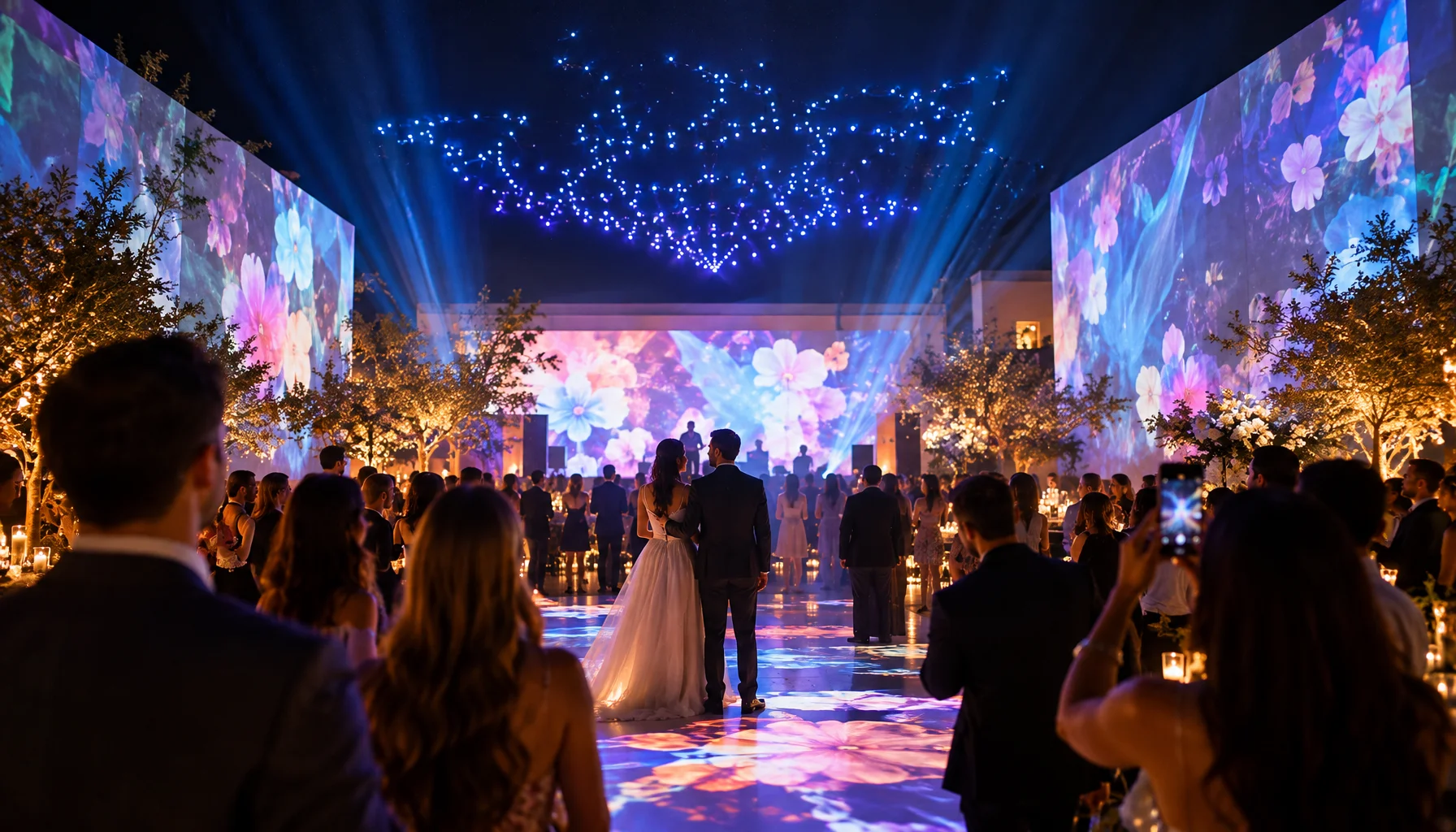
Designing a Wedding Guests Can Enter: Light, Sound, Projection and Participation
The most memorable wedding experiences are rarely created by one spectacular device. They emerge when space, light, sound, movement and participation change together at the right moment. This guide explores projection mapping, interactive environments, spatial sound, drone shows and experiential choreography — and how to design them around the people in the room rather than the technology behind them.
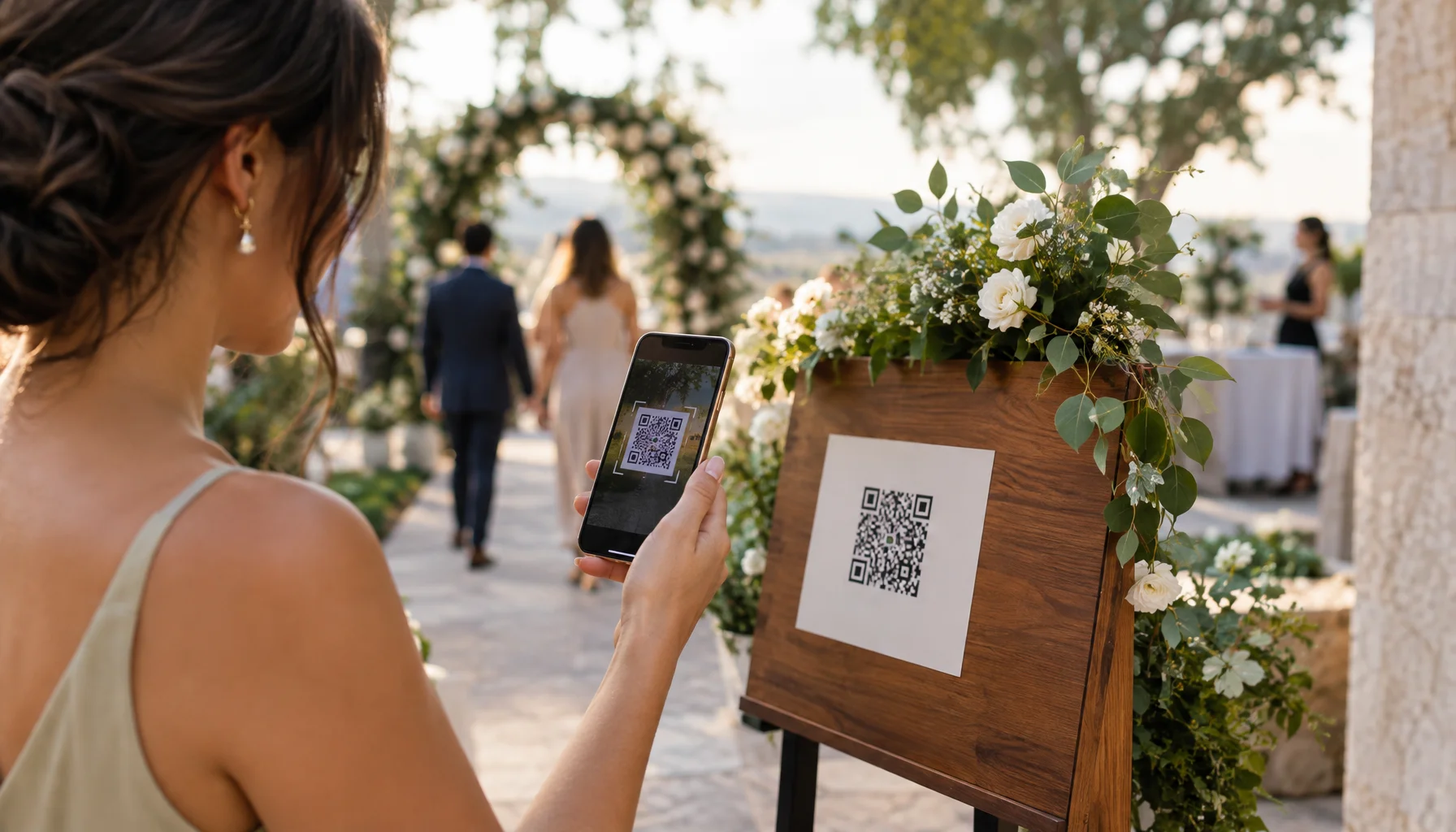
The Invisible Wedding Operating System: QR, NFC, Digital Passes and Real-Time Guest Journeys
Smart wedding technology does not need to look futuristic. A QR code can replace a queue, an NFC tap can reveal the right information at the right place, a digital pass can change when the schedule changes, and one connected guest list can follow someone from RSVP to seating and arrival. The real opportunity is not more screens — it is a wedding that quietly knows what information people need and when they need it.
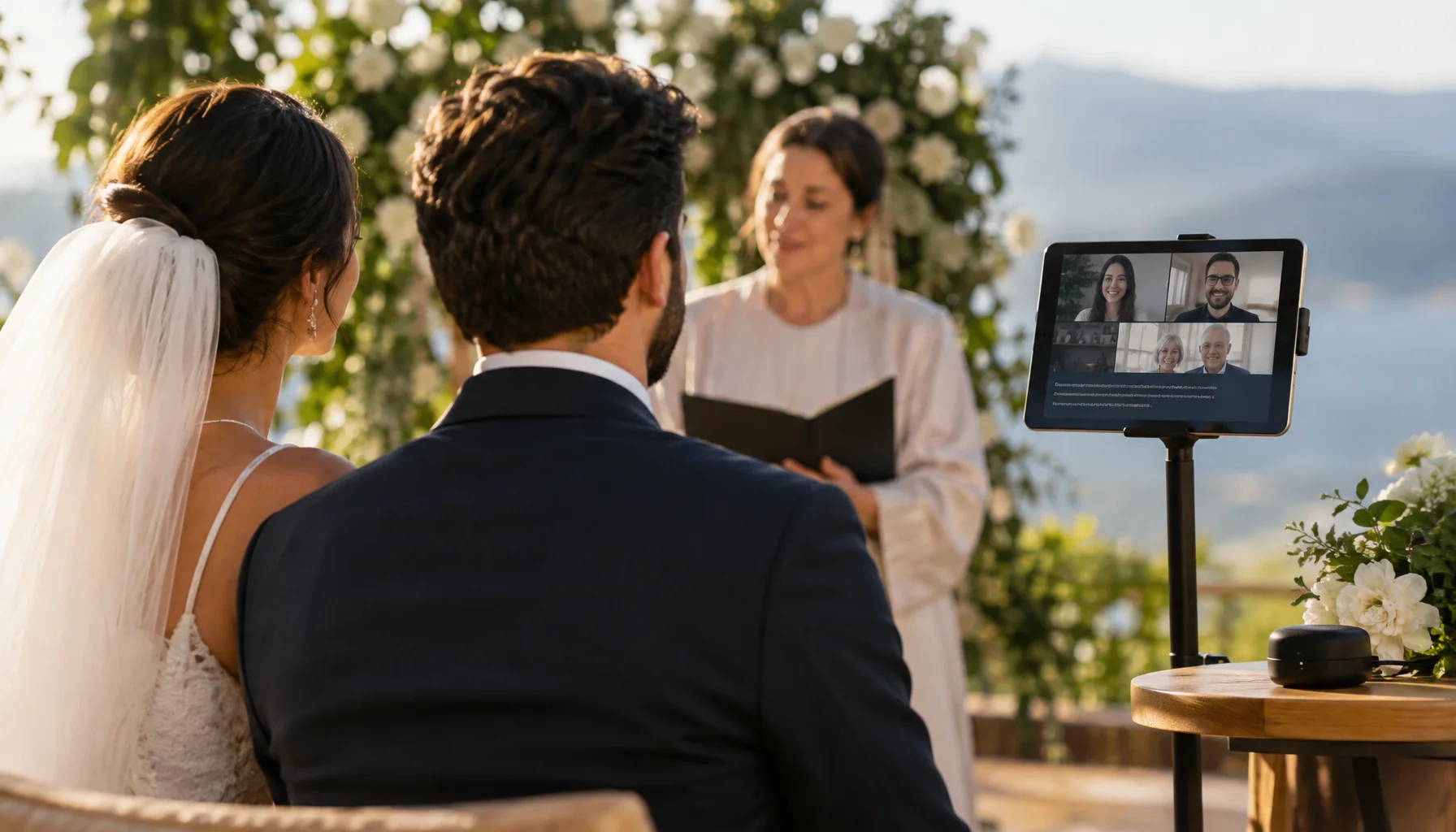
Wedding Technology Should Disappear: Translation, Captions and Shared Presence
The best wedding technology does not demand attention. It helps people understand a ceremony, hear what matters, participate across languages or distance, and then recedes into the background. This guide looks at live translation, captions, remote participation and AI-assisted communication as experience infrastructure rather than wedding gadgets.