
Marriage Certificate Checklist: Why One Document Keeps Returning After the Wedding
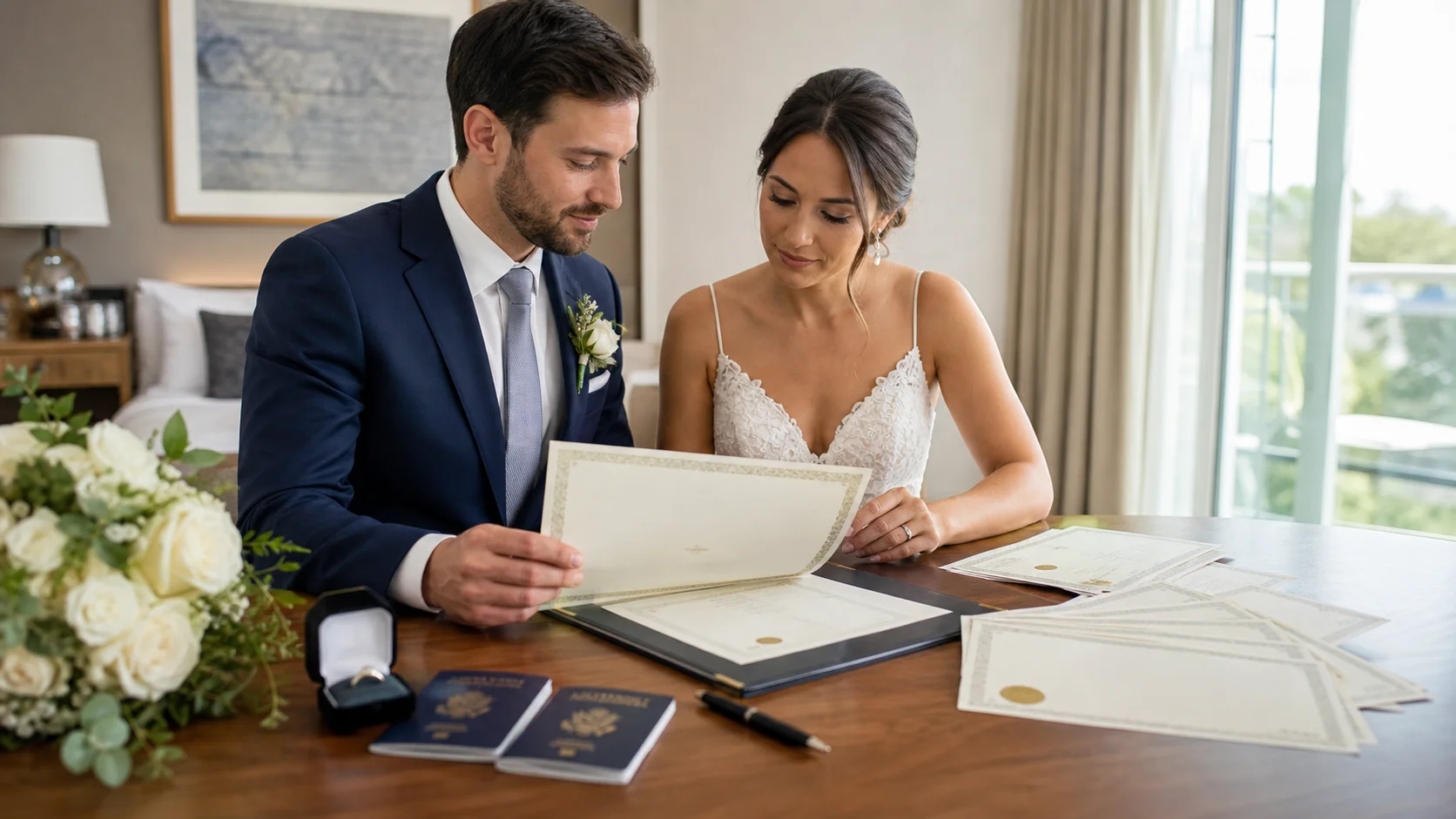
A marriage certificate often feels like the closing document of a wedding. It proves the legal part happened, gives the day an official date, and usually disappears into a folder soon after. Then it returns. A bank asks for it. A passport office needs it. A name change depends on it. An insurance company wants a copy. A foreign authority may not accept it without translation or apostille. What looked like one paper from the ceremony becomes a document that keeps stepping back into ordinary life.
That is why a marriage certificate checklist should begin before the couple actually needs the certificate again. The question is not only where the document is stored. It is how many copies exist, whether they are certified, whether a digital scan is usable, whether the certificate needs translation, and which institutions will ask for the original. Couples often notice too late that the certificate is not simply a keepsake. It is a key, and sometimes several doors ask for it at the same time.
Definition
A marriage certificate checklist helps couples manage the official proof of marriage after the wedding. It covers original documents, certified copies, scans, translations, apostilles, name changes, travel, banking, insurance, tax records, residence matters, storage, and the situations where one document becomes necessary again long after the celebration is over.
One Original Is Usually Not Enough For Real Life
Couples often assume one official certificate is enough because it feels important. In practice, one original can become awkward quickly. Some offices want to see it in person. Others accept only certified copies. A few may keep a copy on file. If the couple is changing names, updating documents, applying for benefits, arranging residence matters, or dealing with cross-border paperwork, several requests can overlap. A useful legal documents checklist should ask how many certified copies are sensible, where the original stays, and which process should never depend on sending the only copy away.
Scans Help, But They Do Not Replace Everything
A clean digital scan is still worth making early. It helps with quick questions, email requests, internal records, insurance files, and remembering exactly what the document says without opening a safe place every time. But couples should not assume a scan will be accepted everywhere. Some institutions want certified copies. Some need original stamps. Some reject photographs or cropped phone images. The safest approach is simple: scan the certificate neatly, store it securely, and still keep certified paper copies available for the parts of life that remain stubbornly physical.
Legal & Documents (Info) – CategoryLegal matters and required documents are an important part of wedding planning. Depending on where you get married, different legal requirements, paperwork, and official registrations may apply. Taking care of these aspects early helps avoid delays, ensures your marriage is legally valid, and allows you to focus on the joyful parts of your celebration. With the right preparation and information, handling legal and administrative tasks can be a smooth part of the planning process.
Translation And Apostille Should Not Be Left Until Someone Asks
International couples, destination weddings, moves abroad, foreign passports, visas, residence permits, and overseas banking can all bring the certificate back into view. In those cases, translation or apostille may matter. The exact requirement depends on the country and authority, so couples should check official sources before assuming anything. What should not be left until the last minute is the possibility itself. A translated or apostilled certificate can take time, and the delay usually appears when a deadline is already close.
Name Changes Often Make The Certificate Work Harder
For couples changing names after marriage, the certificate becomes the bridge between the old and new record. It may be needed for passports, driving licences, banks, employers, tax offices, health insurance, pension records, professional licences, email systems, and travel accounts. This is where the document stops feeling symbolic and starts acting like evidence. A registrar once described the certificate as the document people underestimate because it looks so final. The opposite is often true. It is final enough to prove the marriage, but active enough to keep being requested.
The Certificate Leaves A Quiet Imprint After The Wedding
The connection to imprints is not only visual. A marriage certificate leaves a trace through the systems that recognize the marriage later. It appears in records, applications, folders, scans, envelopes, signatures, and official letters. It carries the date, the names, the place, and sometimes the small administrative facts that outlast the flowers, speeches, and table settings. Some couples frame it. Others file it and barely look at it. Either way, the document keeps marking the marriage in places the wedding itself never reaches.

Some moments do not pass. They settle. Imprints are the emotional traces left by rituals, decisions, and answers that continue shaping relationships long after the moment is gone.
Conclusion
A marriage certificate checklist is useful because the document does not stay in the wedding day. It follows the couple into name changes, travel, banking, insurance, residence questions, family records, and future administration. Keeping the original safe, ordering certified copies, making clean scans, checking translation or apostille needs, and knowing which institutions may ask for it can prevent a small paper problem from becoming a larger delay. The certificate may look quiet in a folder. It is rarely finished with the couple after the wedding.
Related Articles

Wedding Guest Activities That Create Lasting Memories
The wedding activities guests remember most are rarely the loudest. They are the ones that give people something gentle to enter, something quiet to touch, and something small to carry away afterward. This article looks at which kinds of wedding guest activities tend to stay with people and why they often leave a deeper imprint than more spectacular entertainment.

Backup Checklist for Outdoor Weddings: Shade, Wind, Cold, and the Things People Forget
Outdoor wedding backup plans are not only about rain. This article looks at shade, wind, cold, ground conditions, paths, loose details, guest comfort, and the small weather traces that shape how an outdoor celebration is remembered.
How Requests Move Through a Wedding Night
Music requests at weddings are rarely just about songs. They move through timing, confidence, mood, and the different logic of DJs and live bands, shaping the social texture of the night as much as the playlist itself.
Outdoor Weddings With Children: Freedom, Boundaries, and Attention
Outdoor weddings often feel easier with children because there is more room to move, but that same openness changes how boundaries work and how attention is held. This article looks at how freedom, supervision, fatigue, and small shifting moments shape child-friendly outdoor celebrations.

The Groom’s Suit Guide: Planning, Fittings, Trends & Timeline
A wedding suit does not come from a single decision, but from alignment over time. Cut, fabric, and fit develop in relation to occasion, movement, and personality. When these elements settle into place, the suit supports the day quietly and allows the groom to remain fully present.
What Couples Notice Too Late About a Wedding Venue
Wedding venues are often chosen in a moment of projection. Couples imagine light, atmosphere, and feeling long before they understand flow, pressure points, and what the place is actually asking of the day. This article looks at what couples often notice too late about a venue, and why expectation and reality begin separating earlier than most people think.

Engagement Ring and Wedding Ring: Two Moments, One Commitment
Engagement ring and wedding ring mark different stages of the same decision. One appears at the beginning, often tied to a single moment. The other enters daily life and stays there. Their forms, materials, and proportions follow different needs, yet they are meant to exist together. Understanding how they differ helps explain why both matter, and why their combination often says more than either ring alone.
Groom’s Morning Checklist: What Keeps the First Hours Clear and Unforced
The groom’s morning often looks simple from the outside, but it depends on small decisions made early. This article looks at clothing, food, rings, timing, communication, photography, transport, and the quiet rituals that keep the first hours clear without making them feel staged.
Wedding Lighting: Creating Atmosphere That Lasts
Wedding lighting is rarely remembered as equipment. What remains is how a room felt when people entered it, how the evening softened, and how different parts of the celebration seemed to belong together without visible effort. This article looks at wedding lighting as a quiet structure that shapes atmosphere and leaves a lasting imprint.
Winter Weddings: Beautiful Locations, Planning Tips and Ideas
Winter weddings move by a different clock. Light shortens, rooms gather people more closely, and warmth becomes part of the structure of the day. This article looks at winter weddings not only as a seasonal style, but as a form of celebration shaped by atmosphere, containment, and the emotional trace a winter setting leaves behind.
The Maid of Honor at the Wedding
How bridesmaids are chosen, what tasks they perform, and why their presence often remains quiet. A text from observations of weddings, conversations, and moments away from the center.

Bachelor Party – A Day Between Everyday Life and Wedding
A bachelor party is not a loud statement, but a quiet transition. People come together who have accompanied them on their journey so far. For a limited period, nothing is on the agenda except shared time. Planning provides stability, openness creates space. Whether for men or women: What's crucial is that the occasion suits the person. Then something unique emerges. Understated. Enduring.